

Introduction: CSCTRUCK China Tank Truck
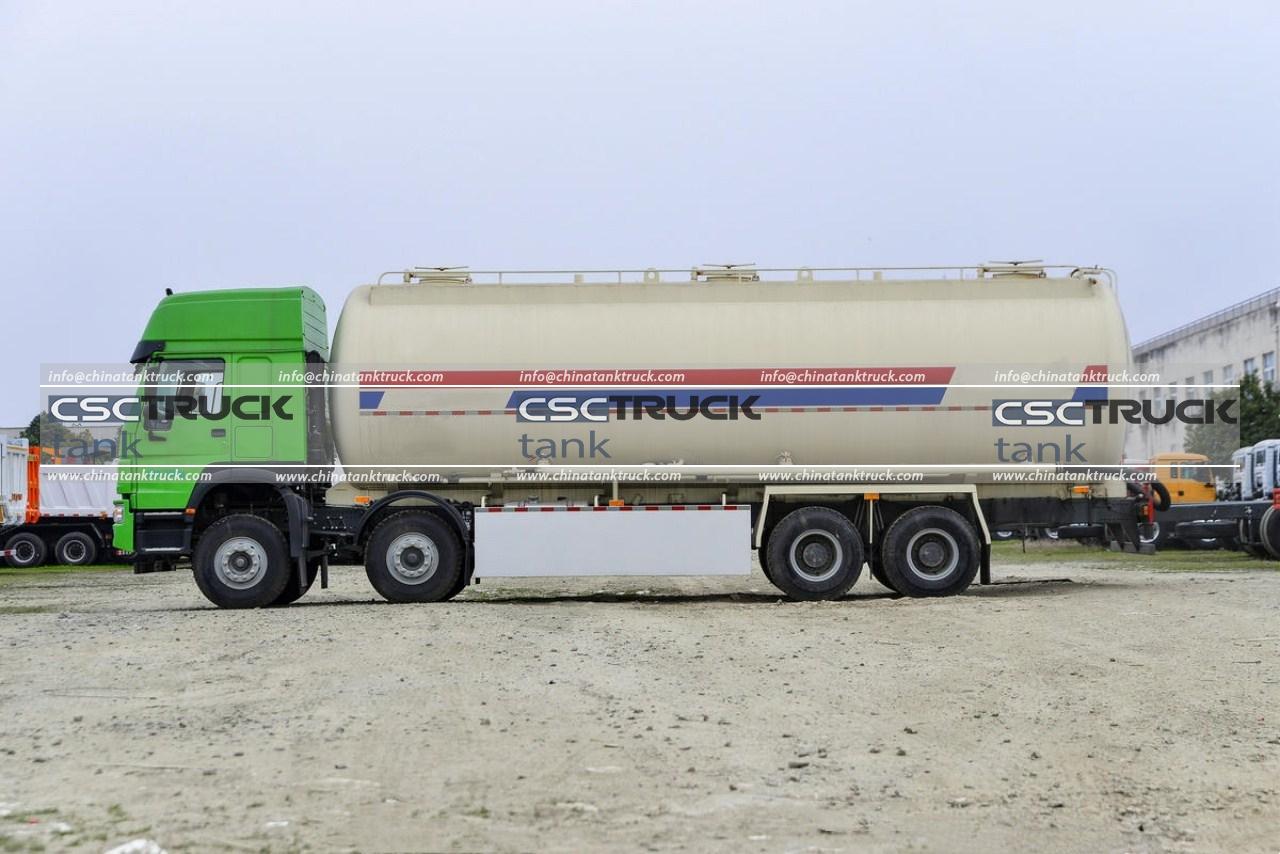
In modern bulk transportation systems, understanding how materials move inside a tank is essential for efficiency, safety, and product quality. One of the leading manufacturers in this field is CSCTRUCK China Tank Truck, a professional producer of tank trucks and specialized vehicles used for transporting liquids, powders, and granular materials. Their pneumatic tank trucks, cement bulk carriers, and dry bulk trailers are widely applied in construction, mining, chemical, and agricultural industries.
Among all these vehicles, pneumatic tank trucks are particularly interesting because they rely not only on gravity, but also on controlled air flow inside the tank to move materials. This internal flow behavior determines how efficiently the tank empties, how much residue remains, and how stable the discharge process is.
To understand this, we need to explore the physics of material flow inside a closed tank system.
1. Basic Principle: Bulk Material Is Not a Liquid
Inside a tank truck, materials such as cement, fly ash, flour, plastic powder, or grain behave very differently from liquids. Unlike water or oil, these are granular or powdered solids, meaning:
- They consist of individual particles
- Friction exists between particles
- Air trapped between particles affects movement
- Flow depends on vibration, pressure, and aeration
Because of these properties, bulk material can behave like:
- A solid (when static)
- A fluid-like medium (when aerated)
- A blocked or “arching” structure (when poorly flowing)
This dual nature is the key to understanding tank flow.

2. Tank Structure and Flow Zones
Inside a pneumatic tank truck, the internal space is typically divided into several functional zones:
(1) Storage Zone
This is the upper part of the tank where material is initially loaded. The material is relatively compacted due to gravity and vehicle vibration during transport.
(2) Fluidization Zone
At the bottom or along aeration pads, compressed air is injected. This air:
- Enters through porous aeration pads or fluidizing plates
- Reduces friction between particles
- Creates a “boiling” or suspended state
Research on bulk solids shows that air injection transforms the material into a fluidized bed, where particles behave similarly to a liquid-like flow state under gas influence.
(3) Hopper and Outlet Zone
This is the discharge area where material exits the tank. The flow behavior here determines whether discharge is smooth or interrupted.
3. How Air Changes Material Behavior
The most important mechanism in a pneumatic tank is air-material interaction.
When compressed air is introduced:
- Air penetrates the void spaces between particles
- Particles separate slightly (reduced contact friction)
- Internal resistance decreases
- Material begins to behave like a flowing fluid
This process is called aeration or fluidization.
However, the airflow must be carefully controlled. If too weak, the material will not flow. If too strong, it can cause:
- Uneven discharge
- “Boiling” or bubbling flow
- Segregation of fine and coarse particles
- Unstable pressure inside the tank

4. Two Main Flow Patterns Inside the Tank
Inside bulk storage and discharge systems like tank trucks, two major flow regimes can occur.
(1) Mass Flow (Ideal Condition)
In mass flow:
- All material moves together
- No stagnant zones exist
- Flow is uniform from top to bottom
This is the most desirable condition for pneumatic tank trucks because it ensures complete discharge and minimal residue.
(2) Funnel Flow (Problematic Condition)
In funnel flow:
- Only the center region moves
- Material near the walls remains stuck
- “Dead zones” develop inside the tank
This leads to:
- Residual material buildup
- Blockage risks
- Uneven discharge rates
5. Internal Forces Driving Material Flow
Material movement inside the tank is driven by 3 main forces:
(1) Gravity
Gravity pulls the material toward the outlet. However, without aeration, gravity alone is not enough for fine powders.
(2) Air Pressure Gradient
Compressed air creates pressure differences inside the tank, pushing material toward the outlet.
(3) Particle Interactions
Friction and cohesion between particles resist flow. Moisture or fine particle size increases cohesion, making flow more difficult.
The balance of these forces determines whether material flows smoothly or forms blockages.
6. The Role of Fluidization Pads
Fluidization pads (often installed at the bottom of pneumatic tanks) are critical components.
They function by:
- Distributing air evenly across the tank bottom
- Creating a uniform particle suspension
- Preventing channeling (air forming narrow paths)
- Supporting steady discharge flow
According to industrial discharge studies, aeration systems are essential for ensuring controlled flow in fine powders like cement or fly ash.
Without proper fluidization, material may compact and resist movement even under high pressure.
7. Flow Inside the Tank During Unloading
The unloading process typically follows these steps:
Step 1: Pressurization
Air is pumped into the sealed tank, increasing internal pressure.
Step 2: Fluidization
Air passes through the material bed, loosening particle structure.
Step 3: Flow Initiation
Material begins to move toward the outlet under combined air pressure and gravity.
Step 4: Stable Discharge
A continuous mixture of air and particles flows through discharge pipes.
Step 5: Deaeration at Outlet
As material exits, air separates and is vented out.

8. Common Flow Problems
Even in advanced systems like those produced by CSCTRUCK China Tank Truck, flow issues may occur:
(1) Arching
Particles form a stable bridge above the outlet, blocking flow.
(2) Ratholing
Only a narrow channel flows while the rest remains stagnant.
(3) Flooding
Excess air causes uncontrolled discharge and material spillage.
(4) Segregation
Fine and coarse particles separate during flow, affecting product consistency.
9. Why Internal Flow Understanding Matters
Understanding internal tank flow is critical because it affects:
- Unloading speed
- Fuel or air consumption
- Vehicle efficiency
- Material quality
- Maintenance cost
- Safety of operation
For example, poor flow may leave 5–10% of material inside the tank, requiring manual cleaning and increasing downtime.

10. Conclusion
Material flow inside a tank is a complex interaction of gravity, air pressure, particle physics, and tank design. Unlike liquids, bulk solids require controlled aeration to behave like a flowing medium.
Manufacturers such as CSCTRUCK China Tank Truck integrate fluidization systems, optimized hopper angles, and aeration technology to ensure smooth discharge in pneumatic tank trucks.
Ultimately, efficient internal flow is what transforms a tank from a simple storage container into a high-performance bulk material transport system—capable of handling everything from cement to fine powders with precision and reliability.
