

A pneumatic tank truck relies on compressed air to move dry bulk materials such as cement, fly ash, lime, flour, plastic pellets, and other powdered or granular products from the tank to a storage silo. Unlike liquid tankers that depend primarily on gravity or pumps, pneumatic trucks require a reliable source of high-pressure air to fluidize the cargo and transport it through discharge pipelines. Understanding how compressed air is generated on a pneumatic truck helps operators maximize unloading efficiency, reduce maintenance costs, and extend equipment life.
Manufacturers such as CSCTRUCK China Tank Truck design pneumatic bulk tankers with integrated air compressor systems engineered for continuous, dependable operation. Founded in 2005, CSCTRUCK China Tank Truck specializes in manufacturing tank trucks for transporting liquids, gases, and dry bulk materials, offering customized solutions for customers worldwide. Their pneumatic tank trucks combine durable tank construction, reliable air systems, and quality-controlled manufacturing to meet the demanding requirements of industries including construction, mining, chemical processing, and food production.
Why Pneumatic Trucks Need Compressed Air
The primary purpose of compressed air is to convert solid bulk material into a fluid-like state. This process, known as fluidization, allows powders and granules to flow smoothly through discharge pipes without mechanical conveyors.
Compressed air performs several important functions:
- Fluidizes dry bulk materials
- Pressurizes the storage tank
- Pushes cargo toward the outlet
- Carries material through unloading pipelines
- Maintains a continuous discharge flow
Without sufficient air pressure and airflow, unloading becomes slow, uneven, or may stop completely due to material bridging or clogging.

The Main Components of the Air Generation System
Several components work together to produce compressed air during unloading.
1. Truck Engine
Everything begins with the truck’s diesel engine.
Rather than installing a separate power source, most pneumatic trucks use the vehicle engine to drive the air compressor. This approach reduces weight, lowers maintenance requirements, and improves fuel efficiency.
When unloading begins, the engine speed is increased to provide enough power for continuous compressor operation.
2. Power Take-Off (PTO)
The Power Take-Off (PTO) transfers mechanical energy from the transmission to the air compressor.
When activated by the operator:
- The PTO engages with the truck transmission.
- Rotational power is transmitted to the compressor.
- The compressor begins generating compressed air.
Many modern trucks use electric or pneumatic PTO controls that allow easy engagement from inside the cab.
3. Air Compressor
The air compressor is the heart of the pneumatic unloading system.
Its job is to draw in atmospheric air and compress it to the pressure required for unloading.
Several compressor types are commonly used.
Rotary Screw Compressors
These are the most common on modern pneumatic trucks.
Advantages include:
- Continuous airflow
- Low vibration
- High efficiency
- Quiet operation
- Long service life
Rotary screw compressors are ideal for unloading cement and other fine powders.

Rotary Vane Compressors
Rotary vane compressors are simpler and less expensive.
Benefits include:
- Compact size
- Lower purchase cost
- Easy maintenance
- Reliable performance
They are often used on medium-capacity pneumatic tankers.
Roots Blowers
Some trucks use Roots blowers instead of traditional compressors.
These systems deliver:
- High air volume
- Lower pressure
- Excellent flow consistency
Roots blowers work particularly well for lightweight bulk materials.

How the Compressor Produces Air
The process is straightforward but highly effective.
Step 1: Air Intake
Fresh atmospheric air enters the compressor through an intake filter.
The filter removes:
- Dust
- Dirt
- Moisture
- Debris
Clean air protects the compressor from wear.
Step 2: Compression
Inside the compressor:
- Air volume decreases.
- Pressure increases.
- Temperature rises.
Depending on the unloading application, discharge pressure typically ranges from 0.8 to 2.5 bar (12–36 psi), although some materials require slightly different operating pressures.
Step 3: Cooling
Compression naturally generates heat.
Many compressors include cooling systems such as:
- Air-cooled radiators
- Oil coolers
- Combination cooling units
Cooling prevents overheating and improves compressor efficiency.
Step 4: Air Delivery
Compressed air exits the compressor and travels toward the tanker through pressure piping.
Before entering the tank, it may pass through:
- Pressure regulators
- Safety valves
- Moisture separators
- Check valves
These components ensure safe and stable operation.
Tank Pressurization
The compressed air enters the sealed tank and increases internal pressure.
Unlike liquid tankers, pneumatic bulk tanks are designed to withstand moderate internal pressure during unloading.
As pressure builds:
- Material becomes fluidized.
- Product begins flowing toward the discharge cone.
- Air carries the product into the unloading hose.
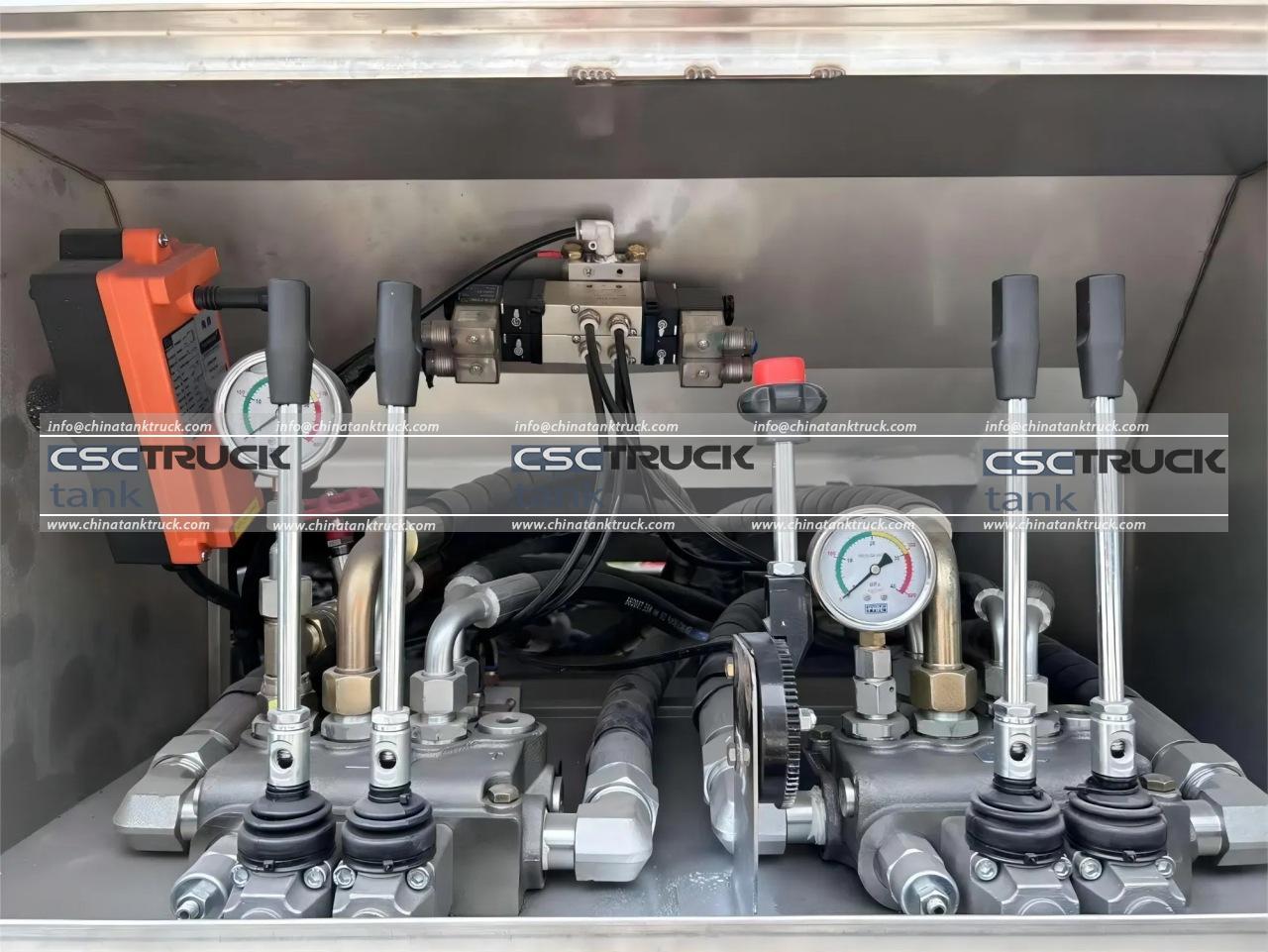
The operator carefully monitors pressure gauges throughout the unloading process.

Air Distribution Inside the Tank
Modern pneumatic tank trucks contain an air distribution system beneath the tank.
This system usually includes:
- Aeration pads
- Fluidizing membranes
- Air channels
- Distribution manifolds
Instead of injecting air at one location, compressed air spreads evenly beneath the cargo.
Uniform airflow prevents:
- Material packing
- Dead zones
- Uneven discharge
- Blockages
Proper fluidization significantly increases unloading speed.
Pressure Control During Unloading
Maintaining the correct pressure is essential.
Too little pressure results in:
- Slow unloading
- Incomplete discharge
- Material bridging
Too much pressure may cause:
- Pipeline wear
- Product degradation
- Excessive compressor load
- Safety valve activation
Operators continuously adjust engine speed and compressor output to maintain stable airflow.

Safety Features
Because compressed air operates under pressure, pneumatic trucks incorporate multiple safety devices.
Common safety equipment includes:
- Pressure relief valves
- Burst discs
- Pressure gauges
- Temperature sensors
- Emergency shut-off valves
- Non-return valves
These devices protect both the equipment and the operator during unloading.
Factors Affecting Air Generation
Several operating conditions influence compressor performance.
Engine Speed
Higher engine RPM generally increases compressor output.
However, excessive RPM can:
- Waste fuel
- Increase wear
- Generate unnecessary heat
Operators follow manufacturer-recommended engine speeds for optimal efficiency.
Compressor Size
Larger tankers require compressors with greater airflow capacity.
Typical compressor capacities range from approximately:
- 300 m³/hour
- 400 m³/hour
- 500 m³/hour
- Over 600 m³/hour
The correct compressor depends on tank volume and the type of material being transported.
Material Characteristics
Different products require different airflow.
For example:
- Cement needs moderate pressure and consistent airflow.
- Fly ash fluidizes easily.
- Lime may require careful pressure control.
- Plastic pellets often need higher airflow but lower pressure.
- Flour requires clean, dry compressed air to maintain product quality.

Maintenance of the Air System
Proper maintenance ensures reliable compressed air generation.
Routine maintenance includes:
- Inspecting air filters
- Checking compressor oil
- Cleaning cooling systems
- Examining belts and couplings
- Testing safety valves
- Inspecting hoses and fittings
- Monitoring pressure gauges
- Replacing worn seals
Preventive maintenance reduces downtime and extends compressor life.
Benefits of Efficient Compressed Air Generation
A properly functioning air system provides numerous operational advantages.
These include:
- Faster unloading times
- Lower fuel consumption
- Reduced equipment wear
- Complete product discharge
- Minimal material loss
- Lower operating costs
- Improved job site productivity
- Greater customer satisfaction
Modern compressor technology also reduces noise levels while improving energy efficiency.
Conclusion
Compressed air is the driving force behind every pneumatic tank truck unloading operation. Generated by an engine-driven air compressor through a Power Take-Off (PTO), the compressed air pressurizes the tank, fluidizes dry bulk materials, and transports them efficiently through discharge pipelines. Components such as intake filters, cooling systems, pressure regulators, aeration pads, and safety valves all work together to ensure reliable and safe unloading.
Choosing a well-designed pneumatic tanker from an experienced manufacturer can make a significant difference in operational efficiency. CSCTRUCK China Tank Truck offers pneumatic tank trucks equipped with dependable air compressor systems, durable tank structures, and customizable configurations for a wide range of dry bulk transportation needs. Through advanced engineering, strict quality control, and comprehensive customer support, CSCTRUCK China Tank Truck continues to provide efficient pneumatic transport solutions for industries around the world.