
Introduction: CSCTRUCK China Tank Truck
CSCTRUCK China Tank Truck is a professional manufacturer specializing in the design and production of various bulk material transport vehicles, including pneumatic tank trucks, powder tankers, and specialized industrial transport equipment. With a focus on efficiency, durability, and safe handling of dry bulk materials, CSCTRUCK China Tank Truck has developed solutions widely used in industries such as cement, fly ash, lime powder, and chemical powders.
Among these applications, one of the more technically challenging materials is carbon black—an ultra-fine industrial powder widely used in rubber, plastics, coatings, inks, and batteries. This raises an important question: Can pneumatic tank trucks effectively transport carbon black?
The short answer is YES—but only under carefully controlled conditions and with the right system design.
Understanding Carbon Black Properties
Carbon black is not a conventional granular solid. It is an extremely fine, lightweight powder produced through the incomplete combustion of hydrocarbons. Its key characteristics include:
- Extremely small particle size (often in the micron or sub-micron range)
- Very low bulk density
- High surface area and strong adsorption ability
- High cohesion and tendency to form agglomerates
- Strong dusting behavior and easy airborne dispersion
Because of these properties, carbon black behaves more like a fluidized aerosol than a typical bulk solid during handling. Research on pneumatic conveying shows that its flow behavior is highly sensitive to air velocity, pressure, and pipe configuration, especially in dense-phase systems where material moves in plugs rather than suspension flow.
These same properties make carbon black both suitable for pneumatic conveying and difficult to control.
How Pneumatic Tank Trucks Work
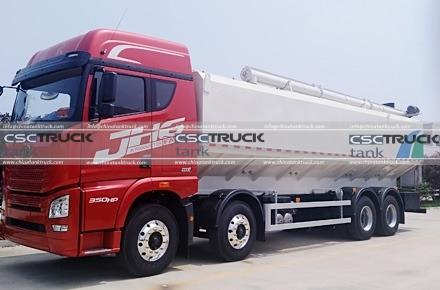
A pneumatic tank truck is a bulk transport vehicle that uses compressed air to unload powdered or granular materials through pipelines. The system typically includes:
- A sealed tank body
- An onboard air compressor or PTO-driven compressor
- Fluidizing pads or aeration systems
- Discharge pipelines and valves
- Control and safety systems
During unloading, compressed air enters the tank, fluidizing the material and pushing it toward the discharge outlet. Depending on the design, the system may operate in:
- Dilute phase conveying (high velocity, suspended particles)
- Dense phase conveying (low velocity, high pressure, plug flow)
For sensitive powders like carbon black, dense-phase conveying is generally preferred.
Can Carbon Black Be Transported by Pneumatic Tank Truck?
1. Technically feasible—but not straightforward
Yes, carbon black can be transported in pneumatic tank trucks. However, it is considered a difficult material due to its cohesiveness and tendency to agglomerate. Industry studies show that fine powders like carbon black require carefully controlled airflow and pressure to avoid blockages, degradation, or excessive dust formation.
2. Dense-phase systems are essential
For carbon black, dense-phase pneumatic conveying is usually required. This mode:
- Uses lower air velocity
- Reduces particle breakage
- Minimizes dust generation
- Improves pipeline stability
Dense-phase systems are widely used in industrial carbon black handling because they reduce degradation and maintain product quality during transport.
3. Risk of clogging and buildup
One of the main challenges is pipeline blockage. Carbon black tends to:
- Stick to pipe walls, especially at bends
- Form deposits due to electrostatic charge
- Agglomerate under improper aeration
If airflow is too low, material may stall. If too high, it can lead to excessive turbulence and system instability.
Key Design Requirements for Transporting Carbon Black
To successfully transport carbon black using a pneumatic tank truck, several engineering conditions must be met:
1. High-efficiency fluidization system
The tank must include effective aeration devices such as:
- Fluidizing pads
- Air distribution cones
- Controlled air injection zones
These ensure that carbon black behaves like a flowing medium rather than a compacted powder.
2. Stable compressed air supply
Airflow must be:
- Consistent in pressure
- Free of moisture
- Precisely controlled
Even small fluctuations can disrupt the dense-phase flow and cause blockages.
3. Anti-static and dust control design
Carbon black generates fine dust and static electricity. Therefore, trucks must include:
- Grounding systems
- Anti-static hoses
- Sealed discharge pipelines
This improves safety and reduces explosion risk in extreme cases.
4. Optimized pipeline configuration
The piping system should:
- Minimize bends and elbows
- Use smooth internal surfaces
- Maintain appropriate diameter ratios
Studies show that bends are critical weak points where carbon black is most likely to deposit and clog.
Advantages of Using Pneumatic Tank Trucks for Carbon Black
Despite the challenges, pneumatic tank trucks remain a practical solution for carbon black transport because they offer:
1. Fully enclosed transport
This eliminates dust leakage, which is critical for environmental compliance and worker safety.
2. High automation efficiency
Loading and unloading can be completed quickly with minimal manual labor.
3. Reduced contamination risk
Sealed systems prevent moisture, dirt, or foreign material contamination.
4. Flexible logistics
Pneumatic trucks can transport carbon black directly to storage silos, reducing intermediate handling steps.
Limitations and Operational Challenges
Even with proper design, several limitations remain:
1. High sensitivity to operating conditions
Small changes in pressure or airflow can significantly affect flow stability.
2. Equipment wear and maintenance
Fine carbon black particles can cause abrasion and long-term buildup in pipelines.
3. Energy consumption
Dense-phase conveying requires careful compression control, which can increase energy usage.
4. Quality degradation risk
Improper handling may break down pellets or alter particle structure, affecting downstream rubber or pigment performance.
Best Practices for Safe and Efficient Transport
To improve reliability, operators typically follow these practices:
- Use dense-phase low-velocity conveying whenever possible
- Maintain dry and clean compressed air
- Regularly clean pipelines and bends
- Monitor pressure and flow rate in real time
- Avoid unnecessary long-distance pneumatic transfer when alternatives exist
In some cases, carbon black is still transported using screw conveyors or bag systems for short distances, especially inside production facilities, because of its handling sensitivity.
Conclusion
So, can pneumatic tank trucks transport carbon black?
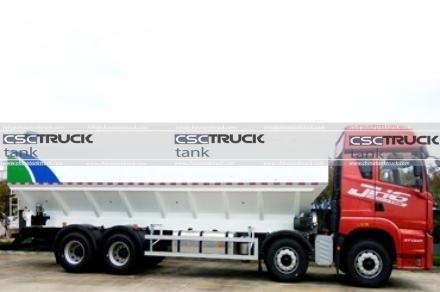
Yes—but only with specialized dense-phase pneumatic systems, strict airflow control, and carefully engineered tank and pipeline design. Carbon black is one of the most challenging powders in industrial bulk transport due to its ultra-fine particle size, strong cohesion, and tendency to form deposits.
When properly designed, however, pneumatic tank trucks provide a safe, efficient, and fully enclosed solution for moving carbon black between production facilities, storage silos, and downstream processing plants.
Manufacturers like CSCTRUCK China Tank Truck continue to develop improved pneumatic transport technologies that make handling such difficult materials more reliable, efficient, and environmentally safe in modern industrial logistics.
