
Milk is a highly perishable food product, so transportation hygiene is an essential part of the dairy supply chain. A milk tank truck must do more than simply carry liquid from a farm to a processing plant. Its tank, valves, hoses, pumps, fittings, and cleaning system must be designed and maintained to minimize contamination and enable effective sanitation.
For example, the U.S. Grade “A” Pasteurized Milk Ordinance requires milk tank trucks and their associated equipment to meet sanitary construction, cleaning, and sanitizing requirements. It specifies that interior surfaces should be smooth, non-absorbent, corrosion-resistant, non-toxic, and maintained in good repair.
This article explains the key hygiene requirements for milk tank trucks and what dairy operators should consider when purchasing or operating one.
1. Use Food-Grade, Hygienic Tank Materials
The tank’s material is one of the most important factors affecting milk hygiene.
Milk tank trucks commonly use food-grade stainless steel, especially SUS304 or SUS316/316L, for milk-contact surfaces. Stainless steel provides corrosion resistance, durability, a smooth, non-porous surface, and good compatibility with repeated cleaning and sanitation cycles.
The FDA’s Grade “A” PMO requires the interior of a milk tank truck to be made from smooth, non-absorbent, corrosion-resistant, non-toxic material.
For this reason, ordinary carbon-steel tanks are generally unsuitable for direct milk contact. A properly manufactured stainless-steel tank also reduces the possibility of milk residues becoming trapped in damaged or corroded surfaces.
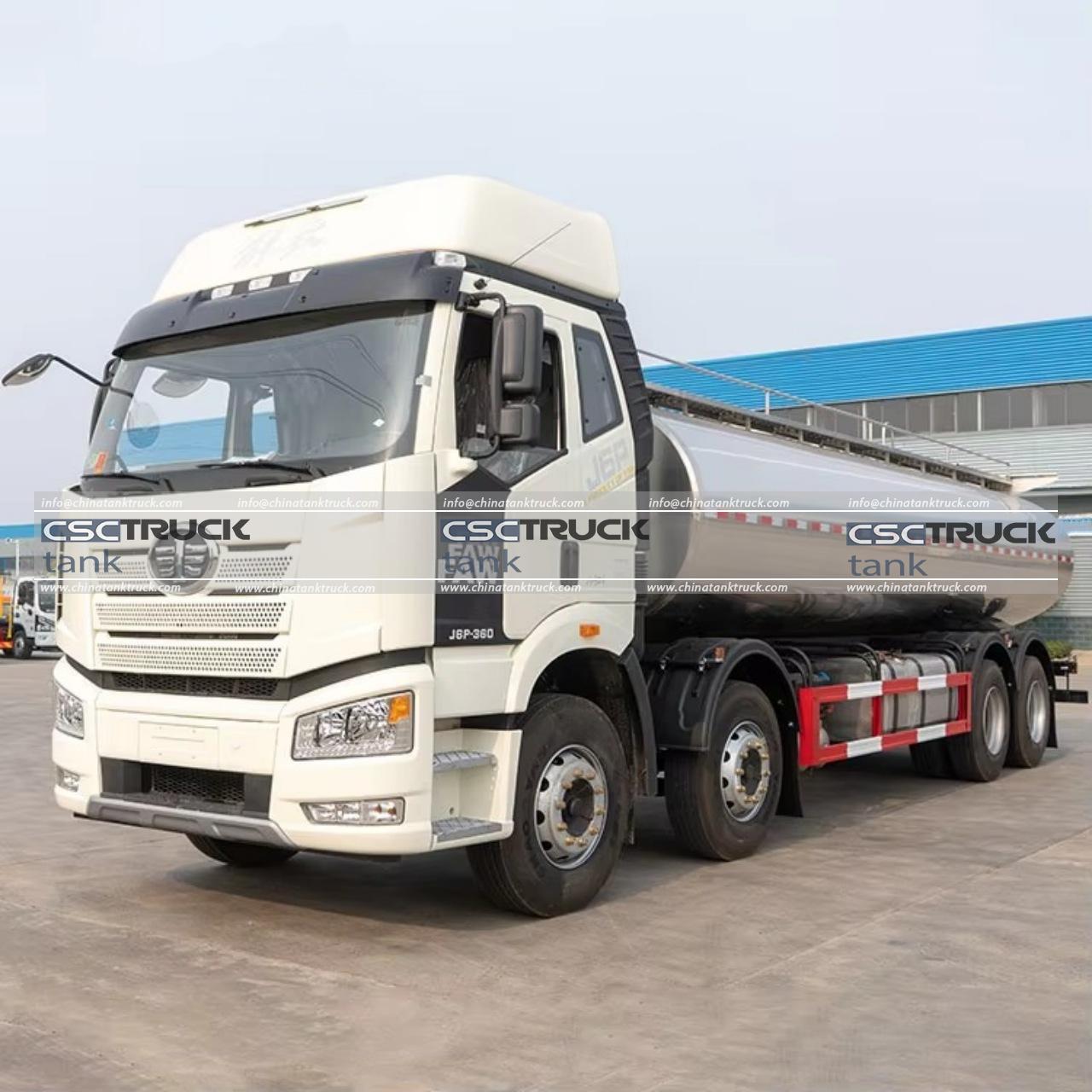
CSCTRUCK China Tank Truck provides specialized milk tank trucks with food-grade stainless-steel tanks. Its current product range includes configurations such as 304 stainless-steel milk tank trucks and milk transport vehicles based on different commercial chassis.
2. Maintain Smooth and Cleanable Internal Surfaces
Food safety depends not only on the stainless-steel grade but also on how the tank is fabricated.
The internal surface should be smooth and easy to clean. Welds should be properly finished, while unnecessary crevices, sharp internal corners, dead zones, and poorly designed connections should be avoided.
Milk contains proteins, fats, lactose, minerals, and other nutrients. If residues remain on the tank surface, they can support microbial growth and potentially contaminate a subsequent load.
A hygienic milk tank therefore typically incorporates:
- Smooth stainless-steel internal surfaces
- Properly finished sanitary welds
- Rounded or hygienically designed corners
- Effective drainage
- Sanitary valves and fittings
- Accessible inspection points
- Food-grade gaskets and hoses
The PMO also specifies that milk-transfer components such as hoses, pumps, and fittings must be made from smooth, non-toxic, cleanable materials and maintained in good repair.
3. Prevent Contamination During Loading and Transport
Hygiene begins before the milk enters the tanker.
During loading, operators should prevent dust, dirt, insects, foreign materials, and other contaminants from entering the tank. Tank openings, manholes, vents, sampling equipment, and transfer connections should therefore be appropriately protected.
The PMO specifically addresses the tank dome lid, vent, and dust cover, requiring them to be designed to protect the milk from contamination.
The same principle applies during unloading. Sanitary pipelines, valves, pumps, and hoses should be protected from environmental contamination when they are not in use.

4. Clean and Sanitize the Tank Regularly
Cleaning and sanitizing are fundamental requirements for milk tank truck hygiene.
The U.S. FDA states that tank trucks used to transport raw milk should be washed and sanitized after each use. The Grade “A” PMO also requires milk tank trucks transporting Grade “A” milk or milk products to be washed and sanitized at an appropriate permitted facility.
A typical cleaning process may include:
- Milk unloading
- Pre-rinsing
- Alkaline cleaning
- Intermediate rinsing
- Acid cleaning when necessary
- Final rinsing
- Sanitization
- Drainage and inspection
The exact procedure, chemicals, temperatures, and cleaning frequency should follow the applicable dairy facility procedures and local regulations.
5. Use CIP Where Appropriate
CIP, or Clean-in-Place, is widely used in modern dairy equipment.
Instead of manually dismantling the entire milk-contact system, CIP circulates water, detergent, and sanitizing solutions through the tank and associated piping. Spray balls or rotating cleaning heads distribute the cleaning solution over the internal surfaces.
A well-designed CIP system can clean:
- Tank walls
- Spray devices
- Milk pipelines
- Pumps
- Valves
- Fittings
- Hoses and other product-contact components
CIP is particularly useful for commercial milk tankers that operate frequently because it provides a more repeatable cleaning process and can reduce manual cleaning work.
However, CIP effectiveness depends on the complete system. Correct cleaning temperature, chemical concentration, flow rate, contact time, spray coverage, and drainage all matter.

6. Ensure Complete Drainage
Standing water or milk residue can become a hygiene problem.
After cleaning, the tank and milk-transfer system should drain effectively. Tank geometry, pipe routing, valves, hoses, and outlets should therefore be designed to minimize areas where liquid can remain trapped.
The PMO specifically requires flexible fluid-transfer systems to be free-draining and appropriately supported to maintain proper slope and alignment.
This is an important purchasing consideration because a tanker can have a high-quality stainless-steel tank but still present sanitation problems if its piping and fittings are poorly designed.
7. Keep Hoses, Pumps, Valves, and Gaskets Hygienic
The tank itself is not the only milk-contact surface.
Milk passes through various components during collection and unloading. These include:
- Milk pumps
- Transfer hoses
- Valves
- Pipework
- Sampling equipment
- Gaskets
- Couplings
- Tank outlets
Every component that contacts milk should be made from suitable food-grade materials and should be easy to clean and inspect.
Damaged gaskets, cracked hoses, worn seals, or poorly maintained valves can create contamination points. Consequently, operators should regularly inspect and replace components according to their condition and applicable maintenance procedures.

8. Protect the Tank From External Contamination
Hygiene also includes the exterior environment around the milk tank.
The tanker should be kept clean and protected from excessive dust, dirt, mud, chemicals, and other contaminants. Equipment cabinets used to store hoses and sampling equipment should also be maintained in a clean condition.
The PMO requires relevant equipment storage areas to protect components from contamination by dust and dirt.
Operators should also avoid storing milk-contact hoses or fittings directly on dirty ground.
9. Maintain Temperature Along With Hygiene
Although temperature control is not itself a cleaning procedure, it is an important part of milk safety.
Raw milk can deteriorate rapidly if temperature is not properly controlled. Milk tank trucks therefore commonly use insulated stainless-steel tanks to reduce temperature changes during transportation.
Insulation, appropriate loading temperatures, transportation time, and local dairy requirements should all be considered when specifying the tanker. CSCTRUCK China Tank Truck milk tank trucks can be configured with insulated tank bodies designed for dairy transportation.
Hygiene and temperature control should be treated as complementary requirements: A clean tanker reduces contamination risk, while appropriate temperature management helps control microbial growth and preserve milk quality.

10. Keep Cleaning and Sanitation Records
Professional dairy operations should not rely only on visual inspection.
Cleaning and sanitation procedures should be documented according to the requirements of the applicable dairy operation and local regulations. Records can help operators verify when a tanker was cleaned, which procedure was used, and whether required checks were completed.
This is particularly important for fleets operating multiple tankers or collecting milk from multiple locations.
What Should Buyers Check Before Purchasing a Milk Tank Truck?
When evaluating a milk tanker, buyers should look beyond capacity and chassis specifications. Important hygiene-related questions include:
| Hygiene Factor | What to Check |
|---|---|
| Tank material | Food-grade stainless steel |
| Internal surface | Smooth, non-absorbent, and easy to clean |
| Welding | Properly finished sanitary welds |
| Drainage | No unnecessary liquid-retention areas |
| Valves and fittings | Sanitary, food-grade construction |
| Hoses | Food-grade and easy to clean |
| CIP | Suitable cleaning coverage and circulation |
| Tank openings | Protection against dust and contamination |
| Insulation | Appropriate for the transport conditions |
| Maintenance | Easy inspection and replacement of components |
The precise requirements can vary by country, dairy processor, type of milk, and applicable food-safety regulations. Therefore, buyers should confirm the required standards before placing an export order.

CSCTRUCK China Tank Truck for Hygienic Milk Transportation
CSCTRUCK China Tank Truck is a Chinese manufacturer and exporter of specialized tank trucks, including milk tank trucks for dairy transportation. Its milk tanker range includes different capacities, chassis brands, stainless-steel configurations, insulation systems, and sanitary equipment.
For dairy farms, milk collection centers, processors, and transportation companies, CSCTRUCK China Tank Truck can provide customized milk tank truck solutions according to capacity, chassis, tank material, insulation, cleaning system, and destination-market requirements.
Conclusion
The hygiene requirements for milk tank trucks cover much more than simply keeping the tank clean. A hygienic tanker should use suitable food-grade materials, have smooth and cleanable internal surfaces, use sanitary valves and hoses, prevent contamination during loading and unloading, provide effective drainage, and undergo systematic cleaning and sanitization.
CIP systems can further improve cleaning consistency, while proper insulation and temperature management help protect milk quality during transportation. Most importantly, the tanker should be designed as a complete sanitary system rather than treating the tank body as the only food-contact component.
For dairy businesses purchasing a milk tank truck, evaluating tank material, sanitary design, CIP capability, drainage, transfer equipment, maintenance, and applicable local regulations together is the best way to establish a reliable hygienic milk transportation system.
