

Milk is a highly perishable food product, so transporting it safely requires much more than simply putting liquid milk into a tank and driving it to a dairy plant. A food-grade milk tanker must be designed to prevent contamination, maintain suitable temperatures, support effective cleaning, and protect milk quality throughout loading, transportation, and unloading.
For dairy farms, milk collection centers, processors, distributors, and fleet operators, understanding these requirements is essential when purchasing or specifying a milk tank truck.
1. Food-Grade Tank Material
The most fundamental requirement is that all surfaces coming into direct contact with milk must be made from suitable food-grade materials.
Stainless steel is widely used for milk tankers because it is corrosion-resistant, durable, smooth, and relatively easy to clean. 304 stainless steel is a common choice for dairy applications, while 316 stainless steel may be selected when higher corrosion resistance or specific customer requirements justify it.
However, simply specifying “stainless steel” is not enough. Buyers should confirm:
- Stainless steel grade
- Internal surface finish
- Welding quality
- Sanitary fittings
- Gasket and seal materials
- Compatibility with cleaning chemicals
The internal tank surface should be smooth and free from unnecessary cracks, crevices, rough welds, or other areas where milk residues and microorganisms could accumulate.
For example, sanitary standards for dairy equipment focus not only on material selection but also on hygienic design, fabrication, and cleanability. 3-A Sanitary Standards specifically includes a standard for stainless-steel automotive transportation tanks used for bulk milk delivery and farm pickup.
2. Hygienic and Easy-to-Clean Design
A food-grade milk tanker must be designed for thorough cleaning and sanitation.
Milk contains proteins, fats, sugars, minerals, and other nutrients that can leave residues on internal surfaces. If these residues are not removed effectively, they can support microbial growth and contaminate subsequent loads.
Important hygienic design features include:
- Smooth internal surfaces
- Properly finished welds
- Sanitary manholes
- Sanitary valves and outlets
- Hygienic pipelines and hoses
- Minimal dead spaces
- Drainable tank construction
- Easy access for inspection and cleaning
The tanker should also be compatible with an appropriate CIP (Clean-in-Place) or manual cleaning procedure, depending on the application.
The objective is simple: After unloading milk, the complete product-contact system should be capable of being effectively cleaned and sanitized before the next load.
3. Effective Thermal Insulation
Temperature control is another major requirement.
Raw milk is perishable, and excessive temperature increases can accelerate bacterial growth and reduce shelf life. Therefore, a milk tanker normally uses an insulated tank to minimize temperature changes during transportation.
A typical insulated milk tank may use a double-wall structure with insulation between the inner and outer tank. Polyurethane insulation is one commonly used option.
The exact thermal requirements depend on:
- Milk temperature at loading
- Transportation distance
- Ambient temperature
- Vehicle operating conditions
- Local dairy regulations
- Required delivery time
Insulation does not necessarily mean that the tanker actively refrigerates the milk. In many applications, the milk is cooled before loading, while the tanker insulation helps maintain the temperature during transportation.
For this reason, buyers should evaluate the complete temperature-control system, rather than looking only at insulation thickness.

4. Sanitary Pumps, Valves, and Piping
The tank body is only one part of a food-grade milk tanker. Every component that contacts milk must also be suitable for sanitary food handling.
This includes:
- Milk pumps
- Valves
- Pipes
- Hoses
- Tank outlets
- Couplings
- Gaskets
- Sampling equipment
A poorly designed valve or pipeline can undermine an otherwise high-quality stainless-steel tank.
Milk-transfer equipment should minimize contamination risks and avoid unnecessary areas where milk can remain trapped. Connections should also be designed so that they can be properly cleaned and inspected.
For dairy operations, sanitary transfer is particularly important because milk may be collected from farms, transported to processing plants, and transferred several times during its journey.
5. Proper Tank Construction and Welding
Food-grade milk tankers require careful fabrication.
The tank must withstand normal road transportation, vibration, loading and unloading operations, cleaning procedures, and repeated use. At the same time, the internal construction must remain hygienic.
Welding is particularly important. Poorly finished welds can create rough surfaces or crevices that are difficult to clean.
A manufacturer should therefore have appropriate procedures for:
- Stainless-steel welding
- Weld inspection
- Leak testing
- Tank fabrication
- Surface finishing
- Final quality inspection
For example, CSCTRUCK China Tank Truck states that its tank trucks undergo quality inspections including welding checks, leak tests, pressure tests, and surface-treatment inspection before delivery.

6. Safe and Hygienic Loading and Unloading
A food-grade tanker should allow milk to be loaded and unloaded without unnecessary exposure to contamination.
The system should provide suitable connections for sanitary milk transfer and should protect product-contact components from dirt and environmental contamination when they are not being used.
Depending on the application, a milk tanker may include:
- Sanitary milk inlet
- Rear or side discharge outlet
- Milk pump
- Sanitary hose
- Sampling port
- Manhole
- Level or temperature monitoring equipment
The exact configuration should match the customer’s collection and delivery process.
7. Compliance With Applicable Standards
There is no single worldwide specification that applies identically to every milk tanker. Requirements depend on the country, application, dairy company, and regulatory system.
Therefore, buyers should identify the standards applicable in their destination market before ordering a tanker.
For example, 3-A Sanitary Standards provide sanitary design requirements for dairy and food equipment. 3-A SSI lists a specific standard, 3-A 05-16, for stainless-steel automotive transportation tanks for bulk delivery and farm pickup service.
3-A SSI also updated its farm milk cooling and holding tank standard in 2026, illustrating that dairy equipment requirements can evolve.
Depending on the market, additional requirements may concern vehicle registration, food-contact materials, sanitation procedures, temperature control, transportation hygiene, electrical systems, and documentation.
Therefore, “food-grade” should not be treated as a universal certification by itself. Buyers should request the specific compliance documents required for their country and application.
8. Suitable Capacity and Vehicle Configuration
A food-grade milk tanker must also be correctly matched to the transportation operation.
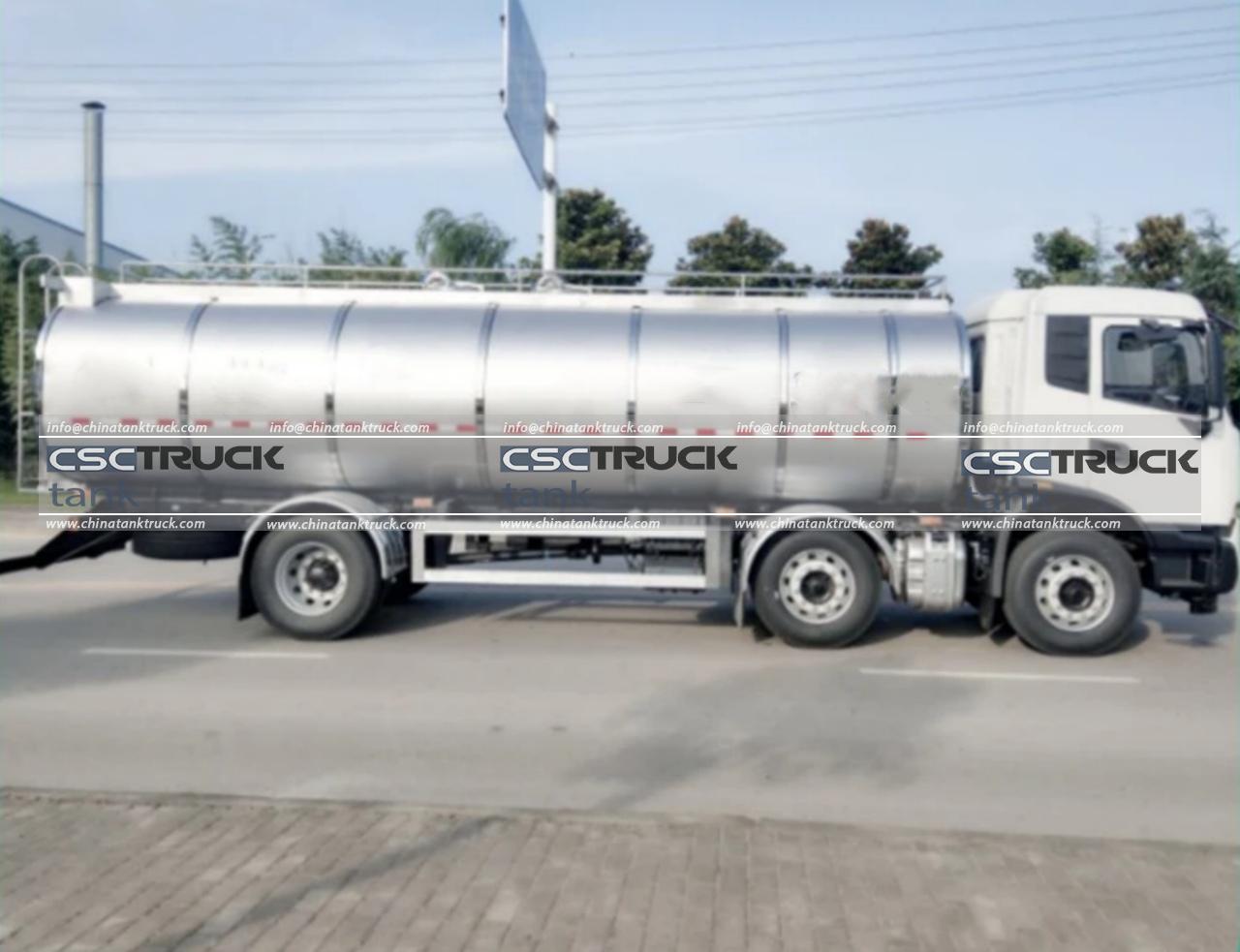
Small milk tank trucks may be suitable for collecting milk from individual farms or smaller collection points, while larger tankers are generally more appropriate for high-volume transportation between collection centers and dairy processing plants.
CSCTRUCK China Tank Truck currently lists milk tanker configurations including a 5,000-liter FOTON milk transportation truck, 6,000-liter 4WD milk transport truck, 10,000-liter ISUZU FVZ milk tanker, and 25,000-liter 304 stainless-steel milk tank truck.
Capacity should be selected according to:
- Daily milk volume
- Collection route
- Road conditions
- Loading facilities
- Maximum permitted vehicle weight
- Transportation distance
- Number of collection points
Oversizing a tanker can increase vehicle and operating costs, while an undersized tanker may require unnecessary trips.
9. Cleaning and Sanitation Procedures
Even the best food-grade milk tanker cannot remain hygienic without proper cleaning.
After unloading, the tank and milk-contact equipment should be cleaned and sanitized according to the applicable dairy operation’s procedures.
A typical process may include:
- Removing remaining milk
- Pre-rinsing
- Cleaning with an appropriate detergent
- Intermediate rinsing
- Sanitizing
- Final drainage
- Inspection before the next loading operation
Cleaning procedures must be compatible with the tank material, seals, valves, pumps, and other components.
Operators should also keep appropriate sanitation and inspection records where required by the applicable food-safety system.

10. What Buyers Should Check Before Purchasing
When purchasing a food-grade milk tanker, buyers should request detailed specifications rather than relying only on the term “food grade.”
A practical checklist includes:
- Tank material: 304 or 316 stainless steel as required
- Internal finish: smooth, hygienic, and cleanable
- Welding: sanitary fabrication and inspection
- Insulation: suitable for the transportation environment
- Milk-contact components: food-grade and sanitary
- Pump: appropriate for hygienic milk transfer
- Valves and pipelines: sanitary design
- Cleaning: compatible with the intended sanitation process
- Capacity: matched to route and payload requirements
- Chassis: suitable for local roads and regulations
- Documentation: certificates and compliance documents required by the destination market
CSCTRUCK China Tank Truck Food-Grade Milk Tankers
CSCTRUCK China Tank Truck is a Chinese manufacturer and exporter of tank trucks and specialized vehicles. Its product range includes milk tank trucks, fuel tankers, water tankers, chemical tank trucks, LPG tankers, and other specialized tank vehicles. The company states that it integrates R&D, manufacturing, quality control, and after-sales service, with tank truck products exported to international markets.
For dairy transportation projects, CSCTRUCK China Tank Truck offers different milk tanker capacities and chassis configurations, including stainless-steel milk tanks designed for food transportation. Buyers can specify requirements such as tank capacity, stainless-steel grade, insulation, pump configuration, chassis brand, and destination-market requirements.

Conclusion
A food-grade milk tanker must satisfy much more than a basic requirement for carrying liquid food. The tank should use appropriate food-contact materials, have hygienic internal surfaces, provide effective insulation, use sanitary pumps and valves, support thorough cleaning, and comply with the standards applicable to its operating market.
When comparing suppliers, dairy companies should evaluate the entire milk transportation system—from tank material and welding to insulation, transfer equipment, cleaning, documentation, and after-sales support.
By specifying these requirements clearly before purchase, buyers can select a milk tanker that better protects milk quality, supports hygienic dairy logistics, and meets the operational and regulatory requirements of their market.
