

Milk is one of the most temperature-sensitive food products in the supply chain. From the moment it leaves the dairy farm, it must be handled carefully to prevent bacterial growth, spoilage, and quality deterioration. A milk tank truck, also known as a dairy tanker or bulk milk transport truck, plays a vital role in moving raw milk safely from farms and collection centers to processing plants.
But how does a milk tanker keep milk cold during transportation, especially in hot weather or over long distances? The answer involves a combination of rapid pre-cooling, high-performance insulation, hygienic tank construction, temperature monitoring, and efficient logistics.
1. Milk Is Cooled Before Entering the Truck
The cooling process usually begins at the dairy farm rather than inside the truck.
Freshly milked milk may have a temperature of approximately 35–38°C (95–100°F). If it remains warm for too long, bacteria can multiply rapidly. Therefore, farms commonly use bulk milk cooling tanks, plate coolers, or refrigeration systems to reduce the milk temperature to approximately 2–4°C (36–39°F), depending on local regulations and dairy requirements.
Once the milk has been sufficiently cooled, it is transferred into the milk tank truck.
This is important because most conventional milk tankers are designed primarily to maintain the existing cold temperature, rather than rapidly cool warm milk from scratch. Starting with properly chilled milk significantly reduces the cooling burden during transportation.

2. Double-Wall Insulation Prevents Heat Transfer
The most important feature of a milk tank truck is its insulated tank body.
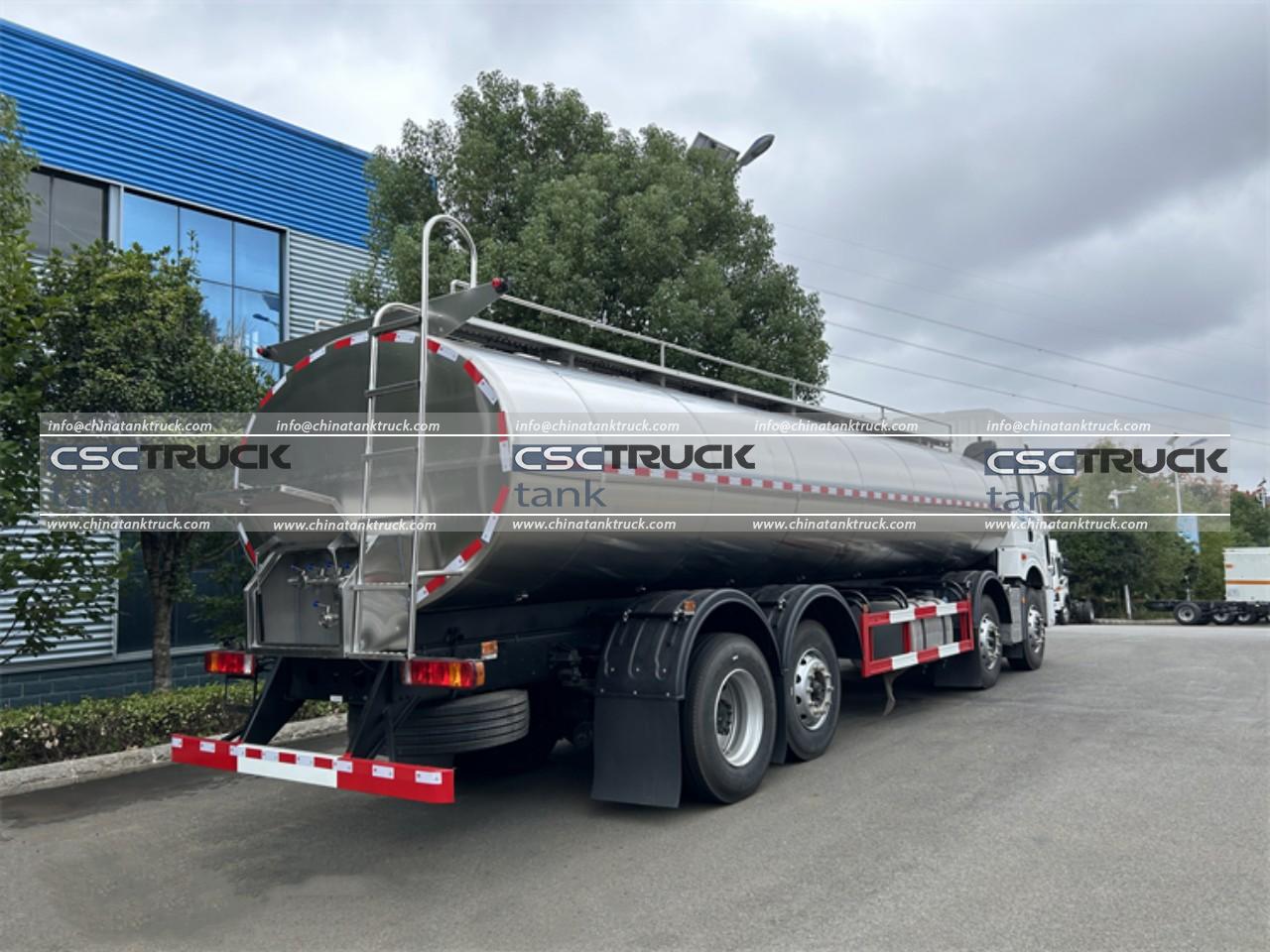
A typical dairy tanker uses a double-wall stainless steel structure, with a thermal insulation layer between the inner and outer tank walls. Polyurethane foam or other high-performance insulation materials are commonly used to reduce heat transfer.
The principle is similar to a large thermos:
- The inner tank contains the chilled milk.
- The insulation slows heat entering from the outside.
- The outer shell protects the insulation and tank structure.
- The milk remains cold for many hours during transit.
This design is especially useful when the truck operates under strong sunlight, high ambient temperatures, or long-distance transport conditions.
High-quality insulation can substantially limit temperature increases during a normal delivery cycle, reducing the need for continuous mechanical refrigeration.
3. Stainless Steel Reflects Heat and Supports Hygiene
Milk tanker interiors are generally manufactured from food-grade stainless steel, commonly AISI 304 or, for certain applications, AISI 316.
Stainless steel contributes to temperature protection in several ways. Its smooth surface is easy to clean and does not absorb milk residues or odors. The outer stainless-steel shell can also help reflect solar radiation, reducing heat absorption compared with darker or less suitable exterior materials.
More importantly, stainless steel is:
- Corrosion-resistant
- Non-porous
- Easy to sanitize
- Durable under road transportation conditions
- Suitable for food-grade milk contact
Keeping milk cold is only one part of quality control. Preventing contamination is equally important because bacteria can spoil milk even when the temperature is properly maintained.

4. Insulation Usually Does More Work Than Active Refrigeration
Many people assume that milk trucks operate like refrigerated delivery vans with a constantly running cooling unit. In reality, many bulk milk transport tankers rely mainly on insulation and pre-cooled milk.
For standard farm-to-processing-plant routes, the tanker is loaded with milk that is already cold. The insulated tank then minimizes temperature gain throughout the journey.
Some specialized milk tank trucks may include:
- Refrigeration units
- Cooling jackets
- Auxiliary cooling systems
- Refrigerated compartments or systems for specific applications
These features may be useful for particularly long routes, hot climates, special dairy products, or operations requiring additional temperature control. However, active refrigeration is not always necessary for conventional bulk raw milk collection.
The exact configuration depends on transport distance, climate, loading temperature, local food-safety regulations, and customer requirements.
5. Fast Loading and Unloading Reduce Temperature Rise
Milk transportation is highly time-sensitive. Even a well-insulated tanker cannot maintain the ideal temperature indefinitely if loading, transport, and unloading are excessively delayed.
Professional milk collection systems therefore focus on:
- Cooling milk quickly after milking.
- Loading it into the tanker without unnecessary delays.
- Keeping the tank sealed during transportation.
- Delivering the milk to the processing facility promptly.
- Unloading through sanitary pipelines and pumps.
The shorter the time between farm collection and processing, the easier it is to preserve milk quality.
Milk tanker trucks are often used on planned routes connecting farms, collection points, and dairy factories. Efficient route planning helps reduce fuel consumption, transportation time, and temperature fluctuation.
6. Temperature Monitoring Ensures Cold-Chain Control
Modern milk tank trucks can be equipped with temperature sensors and monitoring systems that track milk conditions during transportation.
These systems may allow operators to:
- Check milk temperature during loading
- Monitor temperature during transit
- Record temperature history
- Detect abnormal temperature increases
- Verify conditions at unloading
Temperature monitoring is essential for quality assurance because it provides evidence that the milk has remained within the required range.
For example, Canadian dairy transport guidance requires equipment to prevent milk temperature from rising excessively and emphasizes sanitary construction and temperature protection during transport.
7. Gentle Milk Handling Prevents Quality Problems
Milk tank trucks are not simply large containers. Their pumping and piping systems are designed to transfer milk efficiently while minimizing unnecessary agitation.
Excessive turbulence, foaming, or rough handling may negatively affect milk quality, especially during repeated loading and unloading.
A well-designed tanker typically includes:
- Sanitary milk pumps
- Food-grade hoses
- Hygienic valves
- Smooth internal surfaces
- Properly designed inlets and outlets
- Drainable tank structures
Some tankers may also use gentle agitation or circulation systems to maintain uniformity and reduce separation of milk components during storage and transport.

8. Cleaning and Sanitation Help Preserve Milk Quality
A cold tank is not enough if it is contaminated.
After milk is unloaded, the tank must be thoroughly cleaned and sanitized. Many modern dairy tankers use CIP (Clean-in-Place) systems, which circulate cleaning solutions and rinse water through the tank, pipes, valves, and spray devices.
A proper cleaning process helps remove:
- Milk fat
- Protein residues
- Bacteria
- Organic deposits
- Odors and contamination risks
The interior surface must remain hygienic before the next load is collected. Dairy transport vehicles are generally dedicated to milk or other approved food products to avoid cross-contamination.
9. Why Insulation Is Especially Important in Hot Climates
Milk transportation in Africa, the Middle East, Southeast Asia, and other warm regions presents additional challenges. Ambient temperatures can be much higher than the desired milk storage temperature.
In these conditions, a high-quality insulated milk tanker should provide:
- Thick and continuous thermal insulation
- Reliable stainless-steel construction
- Properly sealed tank access points
- Minimal exposure to direct sunlight
- Short transportation cycles
- Accurate temperature monitoring
- Optional active cooling when required
The insulation quality, tank capacity, loading temperature, and transport duration should all be considered when selecting a milk tanker for a specific market.

10. Choosing the Right Milk Tank Truck
When purchasing a milk tank truck, buyers should evaluate more than tank capacity. Important factors include:
- Tank volume: Common configurations range from several thousand liters to large-capacity dairy tankers.
- Insulation performance: Essential for maintaining milk temperature.
- Material: Food-grade stainless steel is preferred for milk contact surfaces.
- Cleaning system: CIP compatibility improves sanitation efficiency.
- Temperature monitoring: Helps ensure compliance and quality control.
- Chassis selection: Depends on road conditions, payload, and operating distance.
- Pump and hose design: Should support hygienic and efficient milk transfer.
- Climate requirements: Hot-weather operations may require enhanced insulation or optional cooling systems.
About CSCTRUCK China Tank Truck
CSCTRUCK China Tank Truck is a Chinese manufacturer and exporter of specialized commercial vehicles, including milk tank trucks, water tankers, fuel tank trucks, chemical tankers, and other liquid vehicles.
CSCTRUCK China Tank Truck provides customized milk tanker solutions for dairy farms, food-processing companies, logistics operators, and international distributors. Its milk tank trucks can be configured according to tank capacity, chassis brand, insulation requirements, sanitary fittings, pumping systems, and customer operating conditions.

Conclusion
A milk tank truck keeps milk cold primarily through pre-cooling at the farm and high-performance thermal insulation during transportation. Stainless-steel construction, sanitary equipment, temperature monitoring, efficient logistics, and proper cleaning work together to preserve milk freshness and safety.
Rather than depending entirely on active refrigeration, most bulk milk tankers are engineered to prevent temperature gain and maintain the cold chain from the dairy farm to the processing plant. For reliable dairy transportation, selecting the correct insulated tank design and maintaining strict handling procedures are essential.
