

Milk is one of the most sensitive products transported by road. Unlike many industrial liquids, milk can quickly spoil when exposed to contamination, unsuitable temperatures, or poor sanitary conditions. For this reason, milk tank trucks are designed very differently from ordinary liquid tankers. One of their most important characteristics is the use of food-grade stainless steel for the tank body.
But why is stainless steel preferred for milk transportation? The answer lies in its combination of hygiene, corrosion resistance, durability, cleanability, and food safety. Stainless steel helps protect milk from contamination while allowing the tanker to withstand repeated washing, transportation, and temperature changes.
1. Stainless Steel Is Hygienic
The primary reason milk tank trucks use stainless steel is hygiene.
Milk contains proteins, fats, sugars, minerals, and water. These nutrients can support microbial growth if milk residues remain inside the tank. Therefore, the tank must have a surface that can be thoroughly cleaned and sanitized after every transportation cycle.
Food-grade stainless steel provides a smooth, non-porous surface that does not easily absorb milk, odors, or contaminants. Properly fabricated and polished stainless steel also minimizes areas where milk residue and bacteria can accumulate.
This is especially important for commercial dairy logistics, where the same tanker may make multiple deliveries every day.
Canadian dairy transport guidelines, for example, specify that milk-contact surfaces must use approved materials, including stainless steel, and require transport tanks to be designed for effective cleaning and sanitation.
2. Stainless Steel Resists Corrosion
Milk is not an extremely aggressive chemical, but it can still contribute to corrosion when a tank is exposed to moisture, cleaning chemicals, and repeated washing cycles.
Stainless steel contains chromium, which forms a protective passive layer on the metal surface. This provides strong resistance to rust and corrosion compared with ordinary carbon steel.
For milk tank trucks, this is particularly valuable because the tank is exposed to:
- Raw milk and dairy residues
- Water and moisture
- Cleaning chemicals
- Hot-water washing
- Disinfectants
- Outdoor weather conditions
Common food-grade stainless steel such as 304 stainless steel offers an effective combination of corrosion resistance, hygiene, mechanical strength, and cost. More corrosion-resistant grades such as 316L may be selected when the application requires additional resistance.
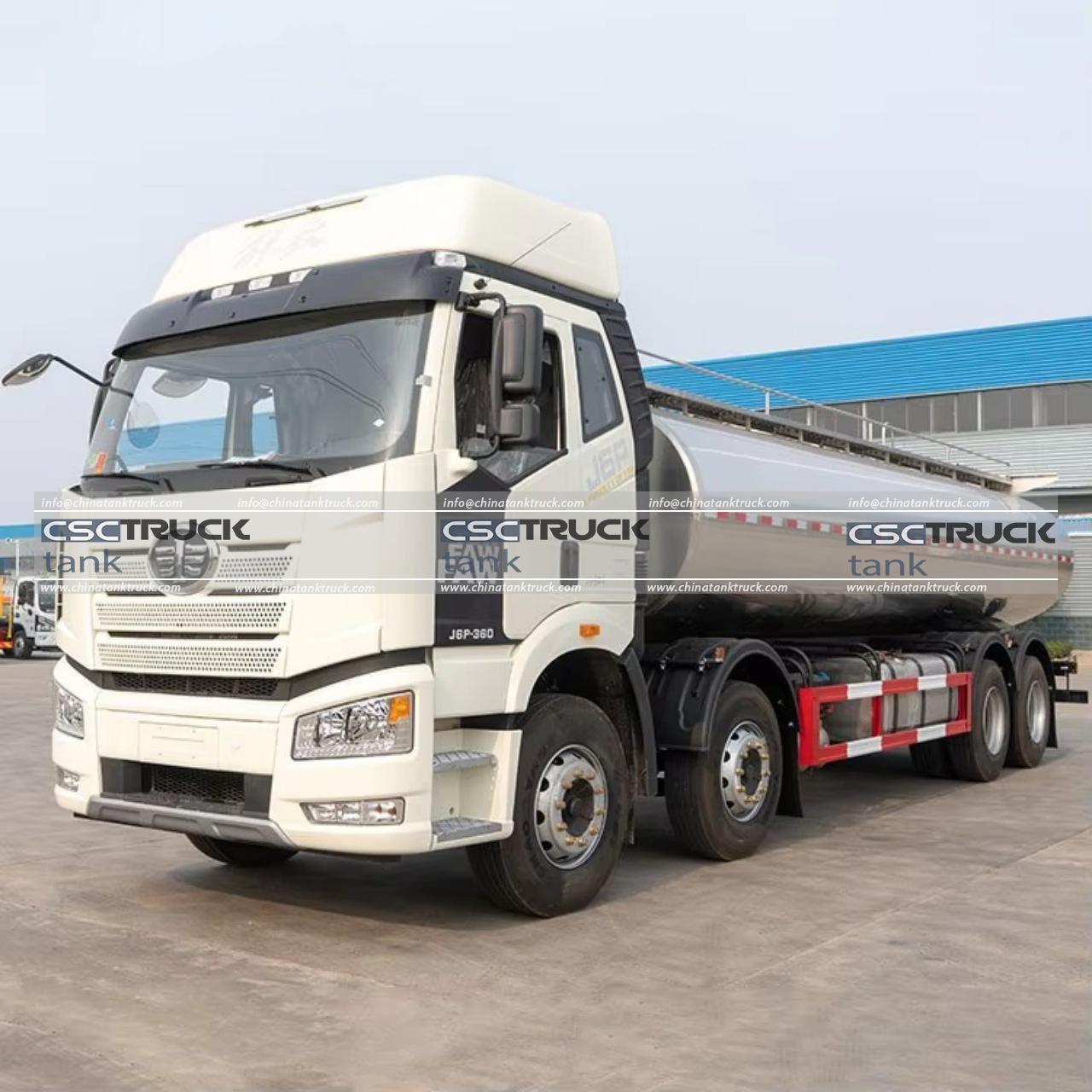
CSCTRUCK China Tank Truck‘s milk tank trucks, for example, can use food-grade 304-2B stainless steel for the tank body. One 25,000-liter model uses a 4 mm 304-2B stainless steel tank.
3. Stainless Steel Does Not Easily React With Milk
Another important advantage is chemical stability.
A milk tank should not introduce unwanted substances, flavors, odors, or metallic contamination into the product. The tank material therefore needs to remain as chemically inert as reasonably possible under normal operating conditions.
Food-grade stainless steel is widely used for dairy-processing equipment because it has good resistance to interaction with food products. This helps preserve the original characteristics of milk during transportation.
This is particularly important when milk is transported over long distances from farms and collection centers to dairy processing plants.

4. It Is Easy to Clean
A milk tanker cannot simply be emptied and reused. It must be properly washed and sanitized between loads.
This is one reason stainless steel is so valuable.
Modern milk tank trucks can incorporate CIP (Clean-in-Place) systems, allowing the internal tank surfaces to be cleaned without completely dismantling the tank. Spray balls or rotating cleaning devices distribute water and cleaning solutions throughout the tank.
For example, a CSCTRUCK China Tank Truck 25,000-liter milk tanker is equipped with an automatic cleaning system using a 360-degree rotating cleaning device.
A well-designed stainless steel tank also allows manufacturers to create smooth welds, rounded areas, sanitary fittings, and drainage structures that reduce residue accumulation.
The result is a tanker that can be cleaned more efficiently between transportation cycles.
5. Stainless Steel Provides Long-Term Durability
Milk tank trucks operate in demanding conditions. They travel on highways, rural roads, farms, and industrial sites while carrying thousands of liters of liquid.
The tank must therefore withstand:
- Road vibration
- Mechanical impacts
- Repeated loading and unloading
- Temperature changes
- Cleaning cycles
- Long-term exposure to moisture
Stainless steel provides high mechanical strength and good resistance to corrosion, making it suitable for long-term tanker operation.
Although stainless steel tank trucks generally cost more than basic carbon-steel alternatives, their durability and lower corrosion risk can help reduce maintenance requirements over the vehicle’s service life.

6. Stainless Steel Works Well With Insulation
Stainless steel itself does not provide refrigeration. However, it works extremely well as part of an insulated milk tank system.
Milk is generally transported under controlled temperature conditions because excessive temperature increases can accelerate bacterial growth and spoilage. A milk tanker therefore commonly uses a double-wall construction with an insulation layer between the inner and outer tank walls.
Common insulation materials include polyurethane foam.
For example, CSCTRUCK China Tank Truck‘s 25,000-liter milk tank truck uses an 80 mm polyurethane insulation layer, designed to limit temperature changes during transportation.
Canadian guidance also requires bulk milk transport tanks to be designed so that milk temperature does not increase by more than 2°C over 24 hours under the specified conditions.
Therefore, the stainless-steel tank and insulation system work together: Stainless steel protects the milk-contact surface, while insulation helps control temperature.
7. Stainless Steel Supports Food-Safe Tank Design
The material is only one part of a hygienic milk tanker. The complete tank must be designed around food safety.
A modern stainless steel milk tank truck may include:
- Food-grade stainless steel tank body
- Polished internal surfaces
- Sanitary valves and fittings
- Food-grade gaskets
- CIP cleaning equipment
- Insulation
- Temperature monitoring
- Hygienic manholes
- Proper drainage
- Baffles to reduce liquid movement
These components work together to reduce contamination and protect milk throughout transportation.

8. Why Not Carbon Steel or Other Materials?
Carbon steel is strong and relatively economical, but it is more vulnerable to corrosion and is generally less suitable for direct food-contact applications without additional protection.
Plastic can provide chemical resistance in some applications, but large commercial milk tank trucks require a combination of structural strength, durability, hygiene, and temperature-control compatibility.
Aluminum is lightweight and can be used in certain tanker applications, but stainless steel remains highly attractive for dairy transportation because of its hygienic characteristics, corrosion resistance, cleanability, and long service life.
For milk transportation, the objective is not simply to carry a large quantity of liquid. The tank must protect the quality and safety of the milk throughout the logistics process.
CSCTRUCK China Tank Truck: Stainless Steel Milk Tank Truck Manufacturer
CSCTRUCK China Tank Truck specializes in special-purpose tank trucks for applications including milk, water, fuel, chemicals, and other liquid cargo.
Its milk tanker range includes different capacities and chassis configurations for local collection, regional distribution, and long-distance dairy transportation. CSCTRUCK China Tank Truck offers food-grade stainless steel tanks, insulation systems, cleaning equipment, and customized configurations according to customer requirements.
For example, its 25,000-liter 304 stainless steel milk tank truck uses an 8×4 configuration, a 290 HP engine, a 4 mm food-grade 304-2B stainless steel tank, 80 mm polyurethane insulation, four compartments, and an automatic cleaning system.
This type of configuration demonstrates why stainless steel is more than simply a construction material—it is an important part of a complete food-grade milk transportation system.

Conclusion
Milk tank trucks are made of stainless steel primarily because dairy transportation requires an exceptionally high level of hygiene, corrosion resistance, cleanability, durability, and product protection.
Food-grade stainless steel helps prevent contamination, resists corrosion, does not easily affect milk quality, and works effectively with CIP cleaning systems and thermal insulation. When combined with sanitary fittings, proper tank design, insulation, and temperature management, it creates a reliable solution for transporting milk from farms and collection centers to dairy processing facilities.
For dairy businesses choosing a milk tanker, the right stainless steel grade, tank capacity, insulation thickness, cleaning system, chassis, and sanitary configuration should all be considered—not just the purchase price.
