
Introduction to CSCTRUCK China Tank Truck
Pneumatic tank trucks are specialized vehicles designed for the efficient transportation and unloading of dry bulk materials, including cement, fly ash, lime powder, flour, chemical powders, and other granular products. One of the most important factors affecting the performance, loading capacity, stability, and road adaptability of a pneumatic tank truck is its axle configuration.
CSCTRUCK China Tank Truck is a professional manufacturer and supplier of tank trucks, offering a range of pneumatic tank truck solutions tailored to various industries and transportation requirements. The company provides pneumatic tank trucks built on different chassis brands and drive configurations, including common 4×2, 6×4, and 8×4 layouts, to meet different payload requirements and road conditions.
Choosing the correct axle configuration is essential because pneumatic tank trucks often carry high-volume but relatively low-density materials. A suitable axle arrangement ensures proper weight distribution, better driving stability, reduced tire wear, and compliance with transportation regulations.
Understanding Pneumatic Tank Truck Axle Configurations
An axle configuration describes the number of axles and the arrangement of driven and steering axles on a truck. It is usually expressed in formats such as 4×2, 6×4, or 8×4.
The first number represents the total number of wheel positions (or wheels), while the second number indicates how many wheels are powered. For example:
- 4×2: Four wheel positions, with two powered wheels
- 6×4: Six wheel positions, with four powered wheels
- 8×4: Eight wheel positions, with four powered wheels
For pneumatic tank trucks, axle selection depends mainly on:
- Tank volume
- Payload requirement
- Road conditions
- Legal weight limits
- Operating distance
- Fuel efficiency expectations

1. 4×2 Pneumatic Tank Truck Configuration
The 4×2 configuration is one of the most common options for small and medium pneumatic tank trucks.
Structure
A typical 4×2 pneumatic tank truck has:
- One front steering axle
- One rear driving axle
This design provides a simple and lightweight structure.
Advantages
The main benefits include:
Lower Operating Cost
Because it has fewer axles and fewer tires, maintenance costs are reduced. Tire replacement, suspension servicing, and fuel consumption are generally lower compared with heavier configurations.
Better Maneuverability
The shorter wheelbase allows the truck to operate effectively in:
- Urban areas
- Construction sites
- Narrow roads
- Local delivery routes
Lower Purchase Price
A 4×2 pneumatic tanker usually costs less than larger multi-axle models, making it suitable for companies that do not require very large transport capacity.
Applications
4×2 pneumatic tank trucks are commonly used for:
- Small cement deliveries
- Local construction projects
- Agricultural powder transportation
- Short-distance industrial supply
However, because of lower axle capacity, they are not ideal for very large tanks or heavy bulk loads.
2. 6×4 Pneumatic Tank Truck Configuration
The 6×4 configuration is a popular choice for medium-duty pneumatic tank trucks.
Structure
A 6×4 truck normally includes:
- One front steering axle
- Two rear axles
- Two powered rear axles
This creates stronger traction and higher load capacity.
Advantages
Higher Payload Capability
Compared with 4×2 models, 6×4 trucks can carry larger pneumatic tanks and heavier loads.
Improved Traction
Driving power is distributed through two rear axles, improving performance on:
- Muddy roads
- Gravel roads
- Mountain routes
- Construction areas
Better Stability
The additional axle improves weight distribution, reducing stress on individual components.
Applications
6×4 pneumatic tank trucks are widely used for:
- Cement transportation
- Mining materials
- Fly ash delivery
- Industrial powder transport
They are especially suitable for medium and long-distance transportation where road conditions vary.

3. 8×4 Pneumatic Tank Truck Configuration
The 8×4 configuration is one of the most widely used heavy-duty options for large pneumatic tank trucks.
CSCTRUCK China Tank Truck offers pneumatic tank trucks using 8×4 chassis configurations, including models designed for large-capacity bulk transport. For example, some CSCTRUCK China Tank Truck pneumatic trucks feature 8×4 drive systems with large-volume tanks around 30–40 cubic meters, providing high loading capability for industrial applications.
Structure
An 8×4 truck typically has:
- Two front steering axles
- Two rear driving axles
This arrangement provides excellent load distribution.
Advantages
Maximum Carrying Capacity
The additional axle allows the truck to support:
- Larger tanks
- Higher payloads
- Heavy-duty operations
Superior Stability
A fully loaded pneumatic tanker can have a high center of gravity. The 8×4 configuration improves stability during:
- Highway driving
- Turning
- Braking
- Uneven road conditions
Reduced Axle Load
The vehicle weight is spread across more axles, reducing stress on roads and improving component durability.
Applications
8×4 pneumatic tank trucks are commonly used for:
- Large cement plants
- Bulk powder logistics companies
- Mining operations
- Long-distance transportation
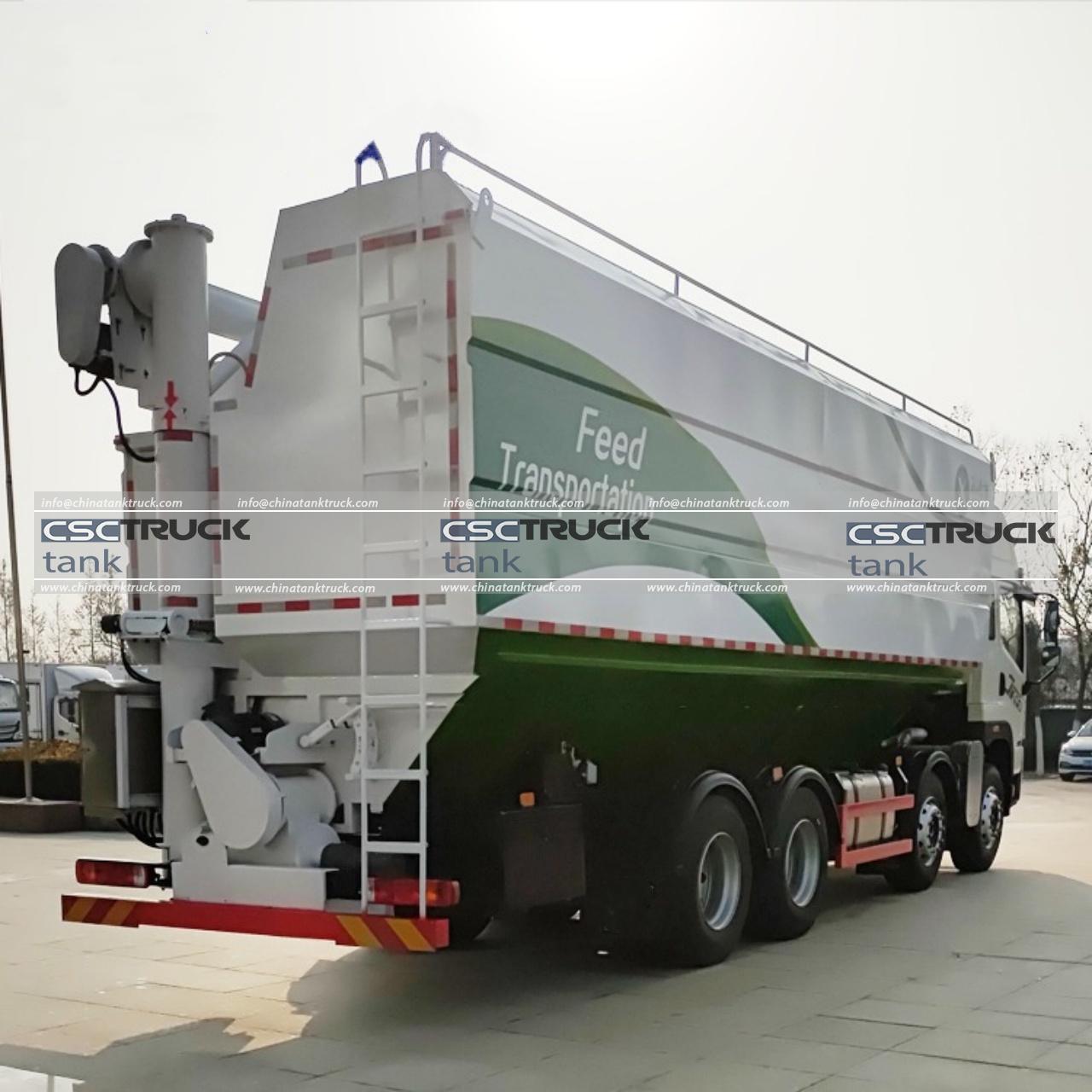
For example, CSCTRUCK China Tank Truck’s 33 CBM pneumatic truck uses an 8×4 drive layout designed for transporting bulk materials such as feed, grain, and powder products.
4. Pneumatic Tank Truck Semi-Trailer Axle Configurations
Besides rigid trucks, pneumatic tank transportation can also use semi-trailer designs.
A pneumatic tanker semi-trailer usually uses:
- Two-axle suspension
- Three-axle suspension
- Multi-axle systems for heavy loads
For example, CSCTRUCK China Tank Truck produces pneumatic tanker semi-trailer solutions with multi-axle suspension systems for larger-volume transport applications.
Advantages of Semi-Trailers
Larger Tank Volume
Semi-trailers can provide significantly higher capacity compared with standard rigid trucks.
Flexible Tractor Selection
The trailer can often be connected with different tractor units depending on transportation needs.
Long-Distance Efficiency
They are suitable for bulk logistics companies requiring high transportation efficiency.

How to Choose the Right Axle Configuration?
Selecting the correct axle configuration requires considering several factors.
1. Required Tank Capacity
Small tanks:
- 4×2 configurations are usually sufficient
Medium tanks:
- 6×4 configurations provide better performance
Large tanks:
- 8×4 or semi-trailer configurations are recommended
2. Road Conditions
For highways and flat roads:
- 4×2 or 6×4 may be adequate
For construction areas or rough terrain:
- 6×4 or 8×4 provides better traction
3. Transportation Distance
Short-distance delivery:
- Smaller axle configurations reduce operating costs
Long-distance transportation:
- Heavy-duty configurations improve reliability and durability
4. Legal Weight Requirements
Different countries and regions have different axle load regulations. A properly selected axle configuration helps operators maximize payload while remaining within legal limits.
Conclusion
The axle configuration of a pneumatic tank truck directly affects its carrying capacity, stability, fuel efficiency, and operating performance. The most common configurations include 4×2, 6×4, and 8×4, each designed for different transportation requirements.
- 4×2 pneumatic tank trucks are economical and suitable for light-duty operations.
- 6×4 pneumatic tank trucks offer a balance between capacity and flexibility.
- 8×4 pneumatic tank trucks provide maximum strength for heavy-duty bulk transportation.
- Multi-axle semi-trailers are ideal for very large-volume logistics operations.
When selecting a pneumatic tank truck, buyers should consider material type, tank volume, road conditions, and operating environment. With professional manufacturing experience and multiple chassis options, CSCTRUCK China Tank Truck provides customized pneumatic tank truck solutions designed to meet diverse global transportation needs.