
Stainless steel milk tank trucks are specialized vehicles designed to collect, transport, and deliver raw or processed milk while protecting product quality and food safety. Unlike ordinary liquid tankers, milk tankers must meet strict requirements for food-contact materials, sanitary design, cleanability, drainage, temperature control, and hygienic operation.
There is no single worldwide standard that applies to every stainless steel milk tank truck. Requirements depend on the destination country, whether the truck transports raw or processed milk, and the dairy customer’s regulatory system. However, several internationally recognized standards and regulations provide a useful framework for buyers and manufacturers.
1. Food-Contact Material Requirements
The first major requirement is that every surface contacting milk must be suitable for food use.
Stainless steel is widely used because it is corrosion-resistant, durable, non-absorbent, and relatively easy to clean. Codex guidance specifically states that surfaces contacting milk should be easy to clean and disinfect, corrosion-resistant, and incapable of transferring substances into milk at levels that could create a health risk.
In practice, buyers commonly specify stainless steel for:
- Inner tank walls
- Milk inlet and outlet pipes
- Valves
- Pumps
- Manways
- Fittings
- Sampling points
- Internal components
The exact stainless steel grade should be confirmed according to the target market and application. AISI 300-series stainless steel is an important benchmark in U.S. sanitary equipment standards. 3-A Sanitary Standards notes that its accepted materials benchmark includes AISI 300-series stainless steel, excluding 301, while materials must also be suitable for sanitary applications and non-toxic.
For this reason, buyers should not evaluate a milk tanker simply by asking whether it is “stainless steel.” They should ask for the specific grade, material certificates, weld quality, and food-contact documentation.

2. 3-A Sanitary Standards in the United States
For milk tank trucks operating in the United States, one of the most relevant references is the 3-A Sanitary Standard for Stainless Steel Automotive Transportation Tanks for Bulk Delivery and Farm Pick-Up Service.
3-A Sanitary Standards, Inc. maintains specific sanitary standards covering dairy and food equipment. Its current catalog identifies 3-A Sanitary Standard 05-16 as “Stainless Steel Automotive Transportation Tanks for Bulk Delivery and Farm Pick-Up Service.”
The 3-A system focuses heavily on sanitary design and fabrication. Important concepts include:
- Smooth product-contact surfaces
- Suitable food-contact materials
- Proper drainage
- Accessible cleaning
- Hygienic fittings and connections
- Appropriate weld construction
- Prevention of contamination
- Sanitary equipment design
3-A standards are important references for U.S. dairy equipment, although 3-A itself explains that its standards are not automatically mandatory under the Grade A milk safety program. Rather, equipment complying with applicable 3-A standards can satisfy sanitary design and construction requirements referenced by the U.S. Grade A milk regulatory framework.
Therefore, U.S. buyers should determine whether their dairy operation, state regulator, or customer specifically requires 3-A compliance or certification.
3. Codex Hygienic Requirements for Milk Transportation
The Codex Alimentarius Code of Hygienic Practice for Milk and Milk Products (CAC/RCP 57-2004) provides internationally recognized guidance for milk production and transportation.
Codex recommends that milk tankers be designed and constructed so that they can be effectively cleaned and disinfected and so that milk can be completely drained. It also states that milk-contact surfaces should be corrosion-resistant and should not transfer harmful substances into milk.
These principles have several practical consequences for stainless steel milk tank trucks.
The tank should not contain areas where milk can accumulate. Internal corners, fittings, valves, pipes, and outlets should therefore be designed to minimize product retention.
Complete drainage is particularly important because residual milk can support microbial growth and create contamination risks during subsequent loading.
Codex also recommends appropriate cleaning and disinfection of milk tankers and associated equipment, including discharge areas and valves.

4. European Union Food Hygiene Requirements
Milk tank trucks operating in the European Union must consider EU food hygiene and food-contact legislation.
Regulation (EC) No. 853/2004 establishes specific hygiene rules for food of animal origin. For equipment, containers, and tanks that come into contact with milk, surfaces must be easy to clean and, where necessary, disinfect. The regulation requires smooth, washable, and non-toxic materials. Transport containers and tanks for raw milk must also be appropriately cleaned and disinfected before reuse.
In addition, food-contact materials placed on the EU market are covered by Regulation (EC) No. 1935/2004. The European Commission explains that food-contact materials must not release constituents into food at levels that could endanger health or cause unacceptable changes to food composition, taste, or odor.
Therefore, an EU-oriented milk tanker should be evaluated not only as a vehicle but also as food-contact equipment.
5. Hygienic Tank Design
Stainless steel alone does not make a tanker sanitary. The entire tank design matters.
A properly designed milk tank should have smooth internal surfaces and minimize dead zones where milk can remain after unloading. Welds should be properly finished so that they do not create difficult-to-clean areas.
Important design considerations include:
Smooth internal surfaces
The inner tank surface should be smooth and free from unnecessary roughness, cracks, pits, or contamination traps.
Complete drainage
The tank should be designed so milk can flow toward the discharge outlet without significant residual accumulation.
Hygienic valves and fittings
Milk-contact valves, hoses, pumps, and connectors should be suitable for food applications and designed for effective cleaning.
Protected connections
Inlet and outlet connections should be protected against dust, dirt, and other contaminants during road transportation.
Insulation
For milk transportation requiring temperature protection, an insulated tank can reduce heat transfer between the milk and the external environment.
6. Cleaning and CIP Considerations
Cleaning is one of the most important requirements for a milk tanker.
Milk contains proteins, fats, sugars, minerals, and microorganisms that can adhere to internal surfaces. Consequently, a tanker needs a cleaning system appropriate for its operating conditions.
Many modern milk tankers can be configured for CIP (Clean-in-Place) systems. CIP allows cleaning solutions and rinse water to circulate through the tank, piping, valves, and other product-contact components without completely dismantling the equipment.
A hygienic tanker design should allow cleaning solutions to reach relevant internal surfaces and should allow the tank to drain after cleaning.
Codex specifically recommends cleaning and disinfection at sufficient frequency to minimize or prevent milk contamination.
7. Temperature and Transportation Requirements
Sanitary construction is only one part of milk transportation safety. Temperature and transportation time are also important.
Codex states that milk should be collected, transported, and delivered in a way that avoids contamination and minimizes microbial growth.
For refrigerated products, the transportation system should maintain appropriate temperature conditions throughout transportation and unloading.
Depending on the application, a milk tank truck may therefore include:
- Thermal insulation
- Temperature monitoring
- Refrigeration or cooling equipment
- Temperature display
- Insulated piping
- Sealed manholes and outlets
The exact temperature requirements should always be determined according to the milk product and destination country’s regulations.

8. Tank Construction and Road-Vehicle Regulations
In addition to food regulations, the truck itself must comply with applicable road-vehicle requirements.
These can cover:
- Gross vehicle weight
- Axle loads
- Dimensions
- Braking systems
- Lighting
- Suspension
- Tank mounting
- Electrical systems
- Vehicle identification
- Roadworthiness
These requirements are separate from sanitary standards. A tanker can have a food-grade stainless steel tank but still require modifications to satisfy local vehicle regulations.
Therefore, buyers should specify both food-contact requirements and chassis/vehicle requirements when ordering a milk tank truck.
9. What Buyers Should Ask a Manufacturer
Before purchasing a stainless steel milk tank truck, buyers should request documentation covering the complete tank system.
Useful questions include:
- What stainless steel grade is used for the milk-contact surfaces?
- Is the material certified for food contact?
- What sanitary standard does the tank follow?
- Is 3-A compliance or certification available where applicable?
- How are internal welds finished?
- Can the tank be completely drained?
- Is the tank designed for CIP cleaning?
- What type of valves and fittings are used?
- Is the tank insulated?
- How is milk temperature monitored?
- What cleaning and disinfection procedures are recommended?
- Can the manufacturer provide material and quality documentation?
These questions help buyers distinguish a purpose-built milk tanker from a conventional stainless steel liquid tanker.

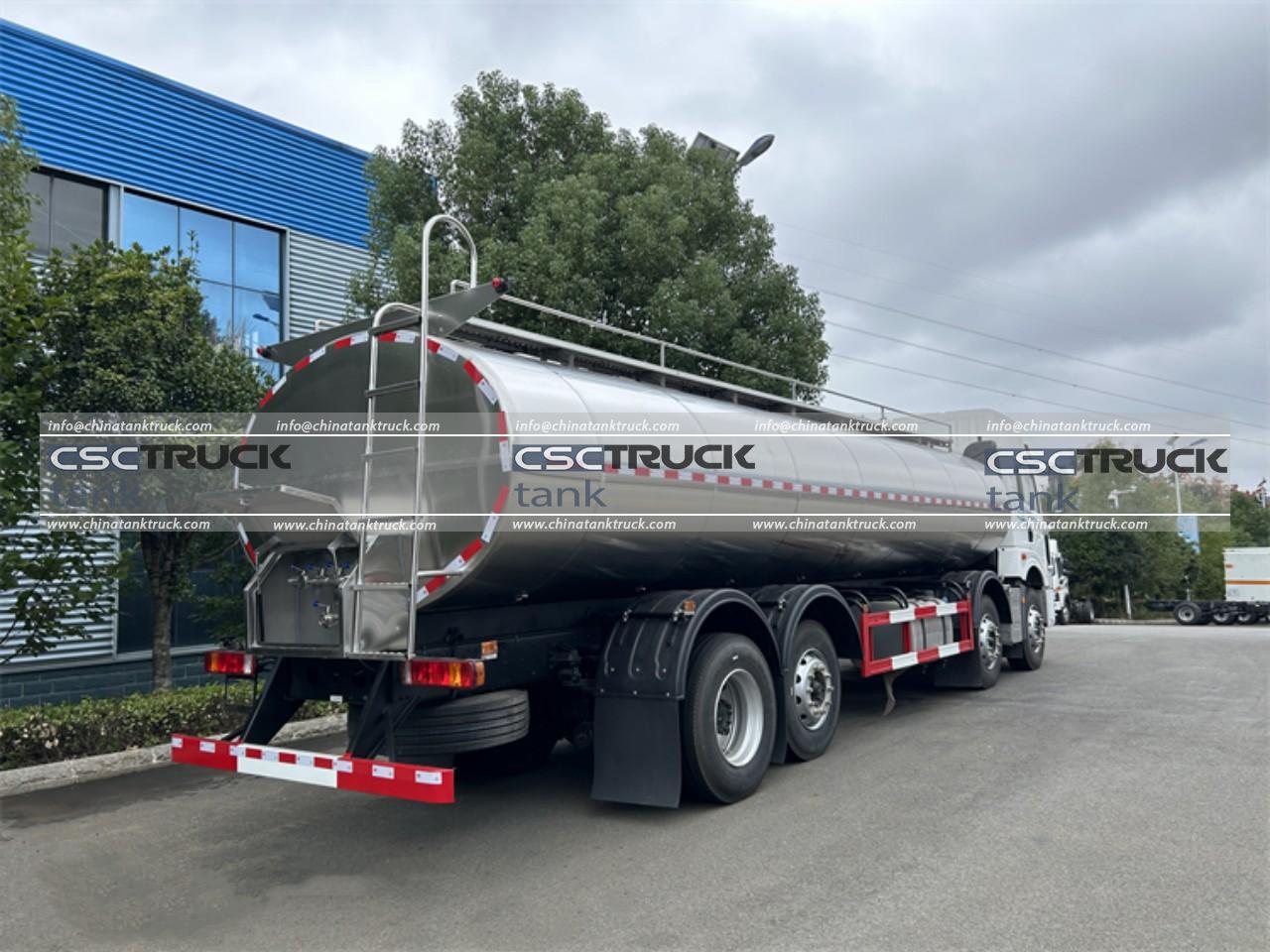
10. CSCTRUCK China Tank Truck Stainless Steel Milk Tank Trucks
CSCTRUCK China Tank Truck is a Chinese special-purpose vehicle manufacturer supplying tank trucks for different transportation applications, including milk transportation.
CSCTRUCK China Tank Truck can configure milk tank trucks according to the required tank capacity, chassis brand, stainless steel construction, insulation, piping, valves, pump system, and export-market requirements.
For international buyers, customization is particularly important because the applicable standards can differ between countries. A tanker intended for the United States may need to address different sanitary requirements from one intended for the European Union, Africa, the Middle East, or Latin America.
CSCTRUCK China Tank Truck‘s engineering and export experience can therefore help buyers define the tank configuration according to the intended application and destination market.
Conclusion
The standards applying to stainless steel milk tank trucks are not limited to 1 specification. Buyers generally need to consider food-contact material requirements, sanitary design, cleaning and disinfection, complete drainage, temperature control, milk hygiene regulations, and road-vehicle requirements.
For international projects, Codex hygienic principles, 3-A sanitary standards, EU food-contact legislation, and national dairy regulations are important reference points. In particular, 3-A Sanitary Standard 05-16 is directly relevant to stainless steel automotive transportation tanks for bulk milk transportation in the U.S.
The most important point is that compliance should be determined according to the destination country and actual milk transportation application. When purchasing a stainless steel milk tank truck, buyers should provide the manufacturer with the target market, required capacity, milk type, temperature requirements, cleaning method, and applicable regulatory requirements before finalizing the tank design.