

● Overview of LNG Tank Trailer Structure
An LNG tank trailer mainly consists of the vehicle chassis, tank body, piping system, and control box.

The tank body is composed of a vacuum-insulated outer shell made of carbon steel and a concentric inner shell made of austenitic stainless steel. The space between the inner and outer shells forms a vacuum layer, typically filled with dozens of layers of aluminum foil and evacuated to a high vacuum level. Adsorbents are also placed in the insulation layer to help maintain the vacuum over time.

Filling and discharging system

Pressure build-up and pressure relief system

Vacuum and measurement system
The rear of the tank is equipped with an operation compartment, where valves and gauges are generally located.
To ensure safe and stable storage and transportation of cryogenic liquids, the tank is equipped with multiple safety devices and monitoring instruments, including pressure build-up and relief systems, safety systems, instrumentation monitoring systems, vacuum and measurement systems, and emergency shut-off systems.
In addition to the above, the LNG tank trailer is also equipped with dry powder fire extinguishers, protective barriers, fenders, static grounding straps, and an emergency shut-off system.
● Maintenance of LNG Tank Trailers
- The operating unit should establish relevant safety operating procedures and management systems based on applicable regulations and its specific situation, and conduct technical safety training for personnel involved in operation, transportation, and management.
- Drivers and escort personnel must be familiar with the physical and chemical properties of the transported medium and its safety precautions. They must understand loading and unloading requirements and be capable of handling faults and emergencies. Drivers and escorts must be trained and certified. The operating unit should provide them with protective equipment, workwear, special maintenance tools, and necessary spare parts.
- The operating unit must strictly follow daily inspection and maintenance routines for tank trailers. Regular inspections should be conducted on safety accessories (e.g., safety valves, pressure gauges, level gauges, boosters, emergency shut-off valves, pipe joints, piping valves, static discharge devices) and checked for leaks or damage. The towing vehicle and its chassis should be maintained per standard repair protocols to ensure proper functionality.
- After the first filling of cryogenic liquid in a new tank trailer, carefully check whether the connection bolts between the tank and the chassis beams are loose. These bolts should be checked regularly during use and tightened if found loose.
- Both pressure gauges on the tank should function normally. If one fails, it must be replaced immediately.

6. Both safety valves on the tank should be operational. If one fails, it can be replaced after being isolated by a 3-way shut-off valve.
7. Pressure gauges should be calibrated every 6 months, and safety valves every year.
8. The vacuum level of the tank’s insulation layer should be checked once a year.
9. All inspections, repairs, or part replacements must be documented and archived.

Emergency Shut-off System
10. Tank inspections and repairs must be conducted by the manufacturer. Valves and instruments can be repaired by qualified personnel from the operating unit.
11. If large areas of the tank’s exterior become frosted or the daily evaporation rate increases abnormally, the manufacturer should be contacted for inspection or repair.
Note: Small areas of localized frost or slight fluctuations in evaporation rate may be related to atmospheric humidity, temperature, or the amount of liquid in the tank. These should be monitored, and the manufacturer should be informed if necessary.
Warning: When disassembling piping, valves, or instruments on the tank, the tank must be empty and depressurized (unless isolated by a valve). Nitrogen purging should be done before maintenance. Operators must wear insulated leather-cotton gloves and goggles or a face shield when handling cold components to avoid cryogenic injuries.
● LNG Tank Trailer Driving and Parking Safety Guidelines
- The following documents must be carried when operating the vehicle:
- Pressure vessel use certificate
- Hazardous materials transport license
- Motor vehicle driver’s license and special tank truck driving permit
- Escort certificate
- Operating license
- Inspection report copy
- Operation logbook and loading/unloading record book

2. Pre-loading inspection must be done. Do not load if any of the following occurs:
- The certificate or permit has expired
- Fails required inspections
- Protective gear, repair tools, or spare parts are missing
- Missing or mismatched documents
- Tank pressure is below 0.1 MPa
- Abnormality in chassis, tank, piping, or safety devices
Warning: Before departure, seal gas and liquid phase ports, and the booster liquid phase port with blind flanges to prevent leakage during transport.
3. Strictly comply with national traffic regulations. Drive at regulated speeds and never speed. Exhaust pipes must be front-mounted with spark arresters. Engines must be shut off in filling/unloading zones, brakes checked, grounding attached, and no open flames nearby.
4. Drive at constant speeds, avoid hard braking, and prevent collisions or accidents. Maintain a safe distance from other vehicles and follow designated routes. Overtaking is strictly prohibited.

5. Escorts must accompany the truck at all times and cannot carry other dangerous goods or passengers. Smoking on board is strictly forbidden.
6. During operation, the escort and driver must monitor internal pressure. If the pressure approaches the safety valve limit, move to a remote area and open the vent valve to relieve pressure. Ensure the cold vapor does not endanger others.
7. In case of malfunction, repair it promptly. If repair is time-consuming or the fault poses a safety risk, move the truck to a safe area and call for professional assistance.
8. Parking must comply with regulations. During roadside stops, neither the driver nor the escort may leave the vehicle unattended. Park in safe locations only.
9. Reduce speed and be cautious when passing through tunnels, underpasses, or overpasses.
10. Avoid driving through densely populated areas. If unavoidable, slow down and do not stop near institutions, schools, factories, warehouses, or crowds.
11. Park in well-ventilated areas. Do not leave the vehicle exposed to direct sunlight for extended periods.
12. If not in use for an extended period, the tank must be drained and maintained at residual pressure.
Note: Always consider environmental safety when parking. Avoid collisions with other vehicles or falling objects.
Warning: Before venting LNG into the air, ensure no open flames, flammables, or passersby are nearby.
● LNG Tank Trailer Emergency Response Plan
If the LNG trailer is exposed to fire:
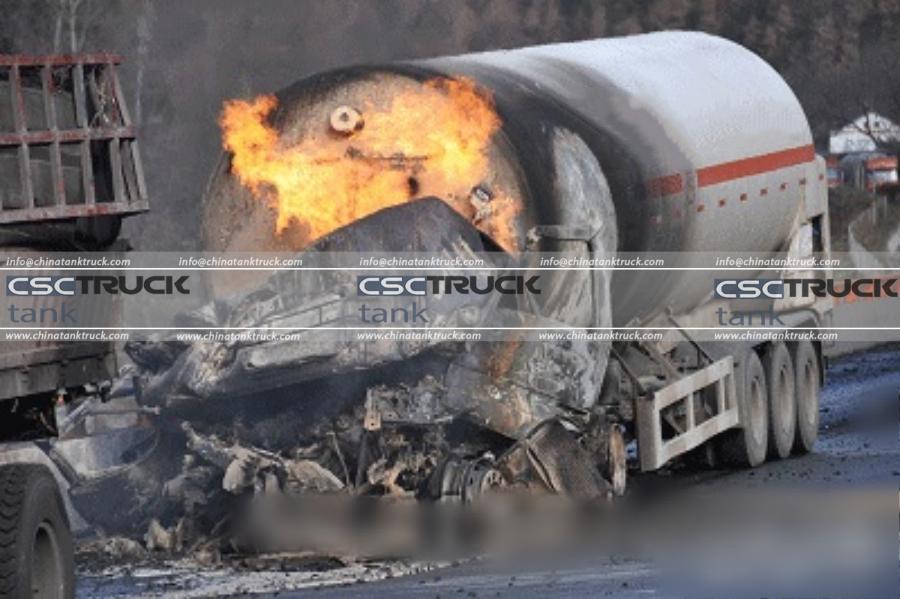
Immediately check and close all gas and liquid phase valves and blind flanges. If valves cannot be shut or leaks cannot be sealed, do not use water to spray directly on leaking LNG. Use dry powder extinguishers (preferably potassium carbonate).
If the LNG trailer is over-pressurized:
Open the overpressure release valve to discharge gas until the safety valve resets. Before venting to the atmosphere, ensure the area is free of open flames, flammables, and people. Secure the perimeter. If the vent valve is ineffective, drive to an open area and vent through the vapor port.
If the LNG trailer loses vacuum insulation:
A vacuum loss will cause the LNG to absorb heat rapidly, increasing internal pressure and liquid expansion. Immediately and carefully discharge the LNG or transfer it to another intact tank. If possible, move the damaged trailer to a safe area free of flames, flammables, and people for emergency handling. Do not allow LNG to remain inside a vacuum-compromised trailer under any circumstances.
If an emergency occurs during loading/unloading:

Immediately close the emergency shut-off valve.
If trailer valves are frozen:
Use clean, oil-free water or warm nitrogen to thaw. Never strike with hammers or tools.
If the trailer overturns or is hit:
Ensure no flames or flammables are nearby. Evacuate personnel and secure a 30-meter perimeter. Call emergency services and notify the company. If vacuum insulation is compromised, carefully discharge or transfer the LNG to another trailer. Move the damaged trailer to a safe location for emergency response.
Note:
- When draining LNG from a damaged trailer, keep the control box at a lower level to facilitate full drainage.
- During overpressure venting:
- Keep the control box at a higher position.
- If recently parked, the initial release may be liquid—this is normal.
- Never vent during transit.